About 219 minutes
Notes of hospital life from November, 1861, to August, 1863 — Edition Insights
Modern Nations
50,203 recorded words. 0 minutes difference from this book's estimate.
View Gutenberg source #54171
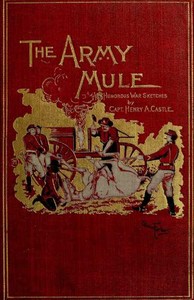
The catalog record for The Army Mule, and Other War Sketches — Story, Setting & Ideas provides practical reading context through 50,209 words, 3 hr 39 min estimated reading time, and 5 detected text sections.
The text analysis averages about 23.2 words per sentence, while the detected sections provide another way to judge how the source is divided.
Project Gutenberg metadata also associates the work with “United States -- History -- Civil War, 1861-1865,” connecting these edition facts with the source record’s subject description.
Explore this collection
These alternatives are selected using recorded categories and estimated reading time.
About 219 minutes
Modern Nations
50,203 recorded words. 0 minutes difference from this book's estimate.
View Gutenberg source #54171About 220 minutes
Modern Nations
50,429 recorded words. 1 minutes difference from this book's estimate.
View Gutenberg source #45024About 224 minutes
Modern Nations
51,363 recorded words. 5 minutes difference from this book's estimate.
View Gutenberg source #43562Search stored excerpts and compare books → Choose by your preferences →
Choices use stored catalog measurements. Estimates vary with reading speed. A shared category is a catalog label, not a claim that two books have the same argument or literary quality.
Search reads excerpt text stored with this catalog and links to its associated Gutenberg record. The connection is stored in the site database; this tool does not recheck that every excerpt is word-for-word identical to that external record. Excerpt search does not cover every chapter and does not verify historical publication dates.
Catalog snapshot checked: 2026-09-26. Coverage: 99 public books, 99 available source excerpts.
Calculated from edition completeness, EPUB availability, text structure and catalogue metadata. Not a user rating.
Total of 100 points, scaled to a 2.5-5.0 range. Editions with an empty description or a missing EPUB file are not scored.
Public-domain source text
The source text is kept in the dedicated reader, separate from this catalogue record and its commentary.
Henry A. Castle opens his collection not with a battle cry but with a mule—specifically, its proverbial longevity and the enduring hallucinations of veterans who claim sole credit for suppressing the rebellion. This wry, self-deprecating tone sets the stage for five sketches that treat army life as a subject for comic and affectionate scrutiny rather than heroic narrative. Castle, a veteran himself, writes from the inside, yet his perspective is that of an amused observer rather than a sentimental chronicler.
The excerpts reveal a writer who delights in elaborate, almost baroque sentences and unexpected analogies: the shelter tent is likened to Diogenes' tub, and the mule's bray is quoted from Coleridge. Readers should expect a voice that is erudite, ironic, and deeply attentive to the mundane details—and absurdities—of soldiering.
The title sketch uses the army mule as a springboard for observations that are simultaneously humorous and philosophical. Castle notes that mules live on until age erects a tumor on their brow, a detail that is both precise and absurd. He contrasts the mule's obliviousness to the war's meaning with the veteran's inflated sense of responsibility. The mule's behavior—darting through an ambulance or climbing a tree when loose—is rendered with a deadpan specificity that invites laughter while also revealing the creature's stubborn, unpredictable nature. Castle's prose here is dense with irony; he treats the mule with a mock-heroic gravity that undercuts any sentimental view of military life. The Coleridge epigraph, celebrating the mule's bray as more musical than fashionable warbling, sets the tone for a sketch that finds dignity and even poetry in the lowly and the dissonant.
In the third sketch, Castle turns his attention to the shelter tent, a piece of equipment he describes as a French device steeped in martial economics. His description is a marvel of extended metaphor: the tent is a supplement to the original war plan, an innovation whose dam was Necessity and whose sire was an emissary of Satan. He traces its evolution from a plastic cell to a full-grown corn in the ear, then distilled and in a cut-glass decanter. The humor lies in the disproportion between the tent's humble reality—a square of cotton—and the grandiose language used to describe its origins and virtues. Castle notes that only ten men can read Plato, implying that understanding the tent's value requires similar rarity. The sketch is less about the tent itself than about the absurdities of military bureaucracy and the gap between official rhetoric and lived experience.
Castle's prose is characterized by long, winding sentences that pile up clauses and digressions. In the shelter tent sketch, he writes: 'It lingers in memory, unique and delectable, dissimilar but equivalent to our ideal of those fringed silken pavilions wherein apoplectic despots of the orient air their scandalous magnificence amid the frockless squalor of their cringing hordes.' This is not the plain style of a field report but the crafted voice of a man who has read widely and enjoys showing it. The humor often arises from the collision between high-flown language and low subject matter. Castle also uses repetition for comic effect, as when he lists the tent's virtues in a crescendo of absurdity. Readers should attend to how the style itself conveys the author's attitude: affectionate but never sentimental, learned but never pedantic.
Across the excerpts, certain details recur that give the sketches their texture. The mule's longevity, the tent's cheapness, the veteran's self-importance—these are not just topics but motifs that Castle returns to with variations. He is attentive to the physical world: the mule's wheeze, the tent's gutta-percha coating, the 'rural Sunday morning cheerfulness' of a stump-sitting observer. These details ground the humor in specific, observable reality. The illustrations by Will Vawter, mentioned in the front matter, likely complement this visual precision. Castle also has a habit of stepping back to make a general observation—about hallucinations, about economy, about the nature of memory—that gives the sketches a reflective dimension. The final sketch, 'The Boys in Blue Grown Gray,' suggests a shift toward elegy, but even there, the tone is likely to be tempered by the irony that runs through the earlier pieces.
Castle's sketches reward a reader who enjoys language as much as incident. The humor is dry, the sentences are intricate, and the perspective is that of a man who has seen the war from the inside but refuses to take it—or himself—too seriously. The excerpts give a strong sense of his voice, but the full collection may reveal a wider range of tone and subject. Approach these sketches as you would a series of essays by a witty, erudite friend who happens to have been a soldier: expect digressions, learned allusions, and a steady undercurrent of affectionate mockery.
The rain against the window kept time with my reading of Henry Castle’s mule, that stubborn, ornery beast somehow easing the absurdity of war. Afterwards, I sat wondering what captivity felt like for those not soldiering. That idle thread pulled me toward Napoleon's British visitors and captives, 1801-1815 — Key Ideas to Explore, another kind of waiting, quieter perhaps, but no less strange.
Capture what you thought, learned, and would like to remember.