About 220 minutes
A Boy Trooper with Sheridan — A Closer Reading
Modern Nations
50,429 recorded words. 4 minutes difference from this book's estimate.
View Gutenberg source #45024
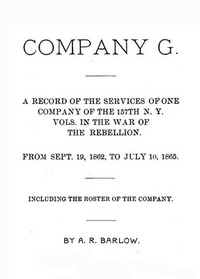
The source record for Company G — Context and Discussion measures this digital text at 51,363 words, 3 hr 44 min estimated reading time, and 5 detected text sections.
The text analysis averages about 15.4 words per sentence, while the detected sections provide another way to judge how the source is divided.
Project Gutenberg metadata also associates the work with “United States -- History -- Civil War, 1861-1865 -- Regimental histories,” connecting these edition facts with the source record’s subject description.
Explore this collection
These alternatives are selected using recorded categories and estimated reading time.
About 220 minutes
Modern Nations
50,429 recorded words. 4 minutes difference from this book's estimate.
View Gutenberg source #45024About 219 minutes
Modern Nations
50,209 recorded words. 5 minutes difference from this book's estimate.
View Gutenberg source #39911About 219 minutes
Modern Nations
50,203 recorded words. 5 minutes difference from this book's estimate.
View Gutenberg source #54171Search stored excerpts and compare books → Choose by your preferences →
Choices use stored catalog measurements. Estimates vary with reading speed. A shared category is a catalog label, not a claim that two books have the same argument or literary quality.
Search reads excerpt text stored with this catalog and links to its associated Gutenberg record. The connection is stored in the site database; this tool does not recheck that every excerpt is word-for-word identical to that external record. Excerpt search does not cover every chapter and does not verify historical publication dates.
Catalog snapshot checked: 2026-09-26. Coverage: 99 public books, 99 available source excerpts.
Calculated from edition completeness, EPUB availability, text structure and catalogue metadata. Not a user rating.
Total of 100 points, scaled to a 2.5-5.0 range. Editions with an empty description or a missing EPUB file are not scored.
Public-domain source text
The source text is kept in the dedicated reader, separate from this catalogue record and its commentary.
Company G is a regimental history with a difference: its author, A. R. Barlow, served in the company he writes about and openly admits to taking grammatical liberties. In his preface, Barlow states that the experiences of Company G were “unique” and that the record should be “drawn uniquely,” warning readers that they will find departures from “good old grammatical paths.” This is not a polished staff report but a veteran’s effort to preserve the deeds of his neighbors from Canastota and vicinity. The book covers the company’s service from September 19, 1862, to July 10, 1865, and includes a full roster. Barlow’s voice is direct, occasionally wry, and unapologetic about calling Confederate soldiers “rebels” or “johnny rebs,” a term he says the men bore with pride.
Barlow’s preface is a rare author’s note that foregrounds the book’s limitations. He writes that the work makes “no claim” as a literary effort, only for “general accuracy in the matter of events and dates.” He expects critics to notice his unusual grammar—individualizing a collective noun while retaining plurality, and “pervert[ing] mood and tense.” This is not carelessness but a conscious choice: the unit’s experiences were themselves irregular, so the telling should match. Barlow also states that he has omitted occurrences that “might not be understood by others than the actors,” suggesting that some inside jokes or local references remain unrecorded. The book is explicitly an “offering to comrades,” not a bid for public acclaim.
The Gettysburg section provides a stark accounting. Barlow describes the 157th’s remnant lying “very flat” on July 2 under concentrated rebel artillery. A night movement goes wrong: a volley from behind a stone wall, the color-bearer wounded, and Captain Place captured while trying to recover the flag. Barlow lists casualties with precision: two officers and twenty-one men died of wounds, making the casualty list “nearly two hundred and sixty men, and fifteen officers.” He names the dead and wounded—Colonel Arrowsmith, Captains Backus and Frank, Lieutenant Lower—and notes that Captain Stone died in prison at Macon, Georgia. The roll call after the battle: thirty-nine privates, eight corporals, four sergeants. The regiment’s entire strength on July 2 was Colonel Brown, Major Carmichael, three officers, and fifty-six men.
Barlow tracks the fates of men who were captured, including Francis M. Gault of Company G, who volunteered to accompany Captain Place and was taken. Gault “had a taste of rebel prisons from Richmond to Andersonville,” returning to the company in April 1865. Another soldier, “Schimmel,” was thought dead but emerged “mighty stiff, but otherwise in fair condition” when Union troops reentered the town on July 4. His comrades “wept; they hugged and kissed the little man.” Barlow also notes that three lieutenants were sent to Macon and later to Charleston, South Carolina, where they were “impounded with other officers.” These details underscore the book’s focus on individual soldiers rather than grand strategy.
Readers should approach Company G as a primary source written by a participant who valued accuracy over polish. Barlow’s frankness about his methods—and his admission that some stories were left out because only the actors would understand them—makes the book both frustrating and valuable. The roster at the end provides a concrete link to the men named in the narrative. For those interested in the Civil War from the perspective of a single company, this is a direct, unvarnished account.
Reading Company G, the clipped casualty lists felt like counting stones in a wall. It put me in mind of sitting with my grandfather, who once showed me a ledger from his great-uncle’s fur trade post—small, careful marks for each pelt, each man lost to winter. Pelts and palisades: The story of fur and the rivalry for pelts in early America — Themes and Context whispered the same quiet ache: how meticulously we record what we cannot keep, hoping the ink holds the warmth.
Answer a few questions and save a private reflection on this device.