About 219 minutes
The Army Mule, and Other War Sketches — Story, Setting & Ideas
Modern Nations
50,209 recorded words. 1 minutes difference from this book's estimate.
View Gutenberg source #39911
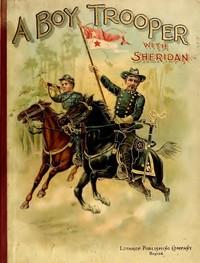
For A Boy Trooper with Sheridan — A Closer Reading, the stored edition analysis reports 50,429 words, 3 hr 40 min estimated reading time, and 7 detected text sections.
The text analysis averages about 17.7 words per sentence, while the detected sections provide another way to judge how the source is divided.
Project Gutenberg metadata also associates the work with “United States -- History -- Civil War, 1861-1865,” connecting these edition facts with the source record’s subject description.
Explore this collection
These alternatives are selected using recorded categories and estimated reading time.
About 219 minutes
Modern Nations
50,209 recorded words. 1 minutes difference from this book's estimate.
View Gutenberg source #39911About 219 minutes
Modern Nations
50,203 recorded words. 1 minutes difference from this book's estimate.
View Gutenberg source #54171About 224 minutes
Modern Nations
51,363 recorded words. 4 minutes difference from this book's estimate.
View Gutenberg source #43562Search stored excerpts and compare books → Choose by your preferences →
Choices use stored catalog measurements. Estimates vary with reading speed. A shared category is a catalog label, not a claim that two books have the same argument or literary quality.
Search reads excerpt text stored with this catalog and links to its associated Gutenberg record. The connection is stored in the site database; this tool does not recheck that every excerpt is word-for-word identical to that external record. Excerpt search does not cover every chapter and does not verify historical publication dates.
Catalog snapshot checked: 2026-09-26. Coverage: 99 public books, 99 available source excerpts.
Calculated from edition completeness, EPUB availability, text structure and catalogue metadata. Not a user rating.
Total of 100 points, scaled to a 2.5-5.0 range. Editions with an empty description or a missing EPUB file are not scored.
Public-domain source text
The source text is kept in the dedicated reader, separate from this catalogue record and its commentary.
Stanton P. Allen was fourteen when he tried to join the Union cavalry, was discovered, arrested for fraud, and bailed out—all before seeing a single battle. His memoir opens with a newspaper clipping that reports this very episode, then lets Allen himself recount the circumstances. That double perspective—public record and private memory—sets the tone for a narrative that is both personal and historically grounded.
Allen writes as a veteran looking back, but he preserves the voice of the boy he was: eager, observant, and quick with a joke. The early chapters trace his path from the Brimmer farm in Berlin, New York, through a second, successful enlistment, to his first camp and the shock of real army life. Readers who begin here will find a narrator who treats his own past with affectionate irony, yet never loses sight of the war's seriousness.
The very first thing Allen gives us is not his own words but a news item from the Troy Daily Times of September 1, 1863. Headlined “More Than He Bargained For,” it reports that one Stanton P. Allen enlisted at fourteen, collected bounty and uniform, and was then hauled before a judge on a writ of habeas corpus obtained by his father. The clipping ends with a warrant for the boy’s arrest for obtaining money under false pretenses.
By placing this external account before his own, Allen does two things. He establishes that his story was public news, not just private memory, and he invites the reader to compare the official version with his own. The clipping is also a neat summary of the memoir’s central tension: a boy too young to fight, yet determined to do so. Readers should watch how Allen returns to this tension—between age and experience, between regulation and reality—throughout the book.
In Chapter VIII, Allen reconstructs a nighttime “council of war” among the enlisted men of his company before the second day of the Battle of the Wilderness. The dialogue is informal, even comic: “I wonder if the Johnnies will skedaddle before morning?” one asks. Another jokes that he can sleep with a clear conscience because his hands are not stained. The men debate whether Grant knows what he is doing, where the general is, and whether they are winning.
This passage is valuable for what it reveals about Allen’s method. He does not claim to remember every word; instead, he recreates the kind of talk that soldiers actually used—speculative, darkly humorous, and grounded in small details like the “old quartz mill” where they had dinner. The council gives readers a sense of how ordinary cavalrymen processed uncertainty. It also shows Allen’s ear for dialogue and his willingness to let the men speak for themselves, without editorializing.
After the council breaks up, Allen tries to sleep but cannot. The day’s events—the attack on the picket line, the charge down the turnpike, the fighting at the rail fence, the retreat, Sheridan’s counterattack—crowd his mind. He tries to arrange them in order for a letter home, but the more he tries, the more “mixed” things become. Finally he drops off, only to be woken for picket duty by a sergeant poking him with a saber scabbard.
This moment is one of the most revealing in the excerpts. Allen admits that the chaos of battle resists neat narrative ordering. His attempt to straighten it out fails; the memory remains jumbled. The interruption by the sergeant—comically abrupt—underscores the way army routine overrides personal reflection. For a first-time reader, this passage signals that Allen’s memoir will not be a polished after-action report but a more honest, fragmented account of what it felt like to be a boy soldier trying to make sense of violence.
General Philip Sheridan appears in the excerpts mainly through the soldiers’ talk and through Allen’s brief, admiring references. In the council of war, one trooper says, “I guess Phil Sheridan knows how to fight his men better'n we know ourselves.” Later, Allen notes that Sheridan “punished” the rebels who pursued them after the first day’s fight. The general is a name, a reputation, a source of orders—but not a person with dialogue or interiority.
This is consistent with the memoir’s focus. Allen is not writing a biography of Sheridan; he is writing about his own experience in Sheridan’s command. The general functions as a symbol of competence and aggression, a figure who gives the troopers confidence. Readers should not expect a detailed portrait of Sheridan. Instead, they will see him through the eyes of the men who served under him—a perspective that is itself a kind of historical evidence.
Allen’s memoir is best read as a record of how one young soldier remembered the war, not as a comprehensive history. The excerpts show a writer who values anecdote, dialogue, and the texture of daily life in camp and on the march. He is candid about the limits of his memory and the confusion of battle. Readers who pay attention to the small moments—the jokes, the complaints, the struggle to stay awake on picket—will find a more intimate account than any official report could provide.
Re-reading Stanton Allen’s boyish zeal under Sheridan, I found myself pondering how a young heart’s loyalty can anchor itself to a fading crown. Allen’s laughter over camp rations gave way to a quieter thought: what it must mean to outlive your own empire’s certainty. That led me back to The life of the emperor Francis Joseph — Story, Setting & Ideas, whose stillness felt like an echo of Allen’s own long, surprised aftermath.
Your answers remain private and are stored only in this browser.