About 100 minutes
Terry's Texas Rangers — Key Ideas to Explore
Modern Nations
22,788 recorded words. 1 minutes difference from this book's estimate.
View Gutenberg source #48103
The source record for Cuba in War Time — Background and Themes measures this digital text at 22,671 words, 1 hr 39 min estimated reading time, and 2 detected text sections.
The text analysis averages about 32.5 words per sentence, while the detected sections provide another way to judge how the source is divided.
Project Gutenberg metadata also associates the work with “Davis, Richard Harding, 1864-1916,” connecting these edition facts with the source record’s subject description.
Explore this collection
These alternatives are selected using recorded categories and estimated reading time.
About 100 minutes
Modern Nations
22,788 recorded words. 1 minutes difference from this book's estimate.
View Gutenberg source #48103About 103 minutes
Modern Nations
23,676 recorded words. 4 minutes difference from this book's estimate.
View Gutenberg source #46344About 92 minutes
Modern Nations
21,045 recorded words. 7 minutes difference from this book's estimate.
View Gutenberg source #32570Search stored excerpts and compare books → Choose by your preferences →
Choices use stored catalog measurements. Estimates vary with reading speed. A shared category is a catalog label, not a claim that two books have the same argument or literary quality.
Search reads excerpt text stored with this catalog and links to its associated Gutenberg record. The connection is stored in the site database; this tool does not recheck that every excerpt is word-for-word identical to that external record. Excerpt search does not cover every chapter and does not verify historical publication dates.
Catalog snapshot checked: 2026-09-26. Coverage: 99 public books, 99 available source excerpts.
Calculated from edition completeness, EPUB availability, text structure and catalogue metadata. Not a user rating.
Total of 100 points, scaled to a 2.5-5.0 range. Editions with an empty description or a missing EPUB file are not scored.
Public-domain source text
The source text is kept in the dedicated reader, separate from this catalogue record and its commentary.
Richard Harding Davis opens Cuba in War Time with a striking analogy: the island, eight hundred miles long, is "studded as thickly with these little forts as is the sole of a brogan with iron nails." This image sets the tone for a report that moves between strategic overview and close-up human moments. Davis, a Fellow of the Royal Geographic Society, traveled through four of Cuba's six provinces in 1896–97, interviewing soldiers, officers, and civilians. His narrative voice shifts from detached analysis to sharp, sometimes sardonic observation, as when he describes a Spanish colonel beating a seventeen-year-old soldier with his staff while the boy holds his salute. The excerpts reveal a writer attentive to absurdity and suffering alike.
Davis repeatedly returns to the Spanish military's reliance on fortifications. He notes that the trocha—a fortified line across the island—is less a barrier than a symbol of a campaign that "may continue indefinitely." His description of the forts as "iron nails" suggests a static, defensive strategy. When he persuades a commandante to let him visit the trocha, he treats the pass from General Weyler as a bureaucratic joke: "as though Mayor Strong had given a man a permit to ride in all the cable cars." This wry tone undercuts the official narrative, hinting at the gap between Spanish authority and on-the-ground reality.
Davis populates his account with minor figures whose stories reveal the war's human texture. The cable operator at Jucaro, isolated for twelve months, greets Davis as "the first white men I've seen since I came here." He passes time with Tit-Bits and Lloyd's Weekly Times, dreaming of Tottenham Court Road. Davis's portrait of the young Spanish conscripts—boys of seventeen who "do not care whether Spain owns an island eighty miles from the United States, or loses it"—underscores the gap between imperial ambition and individual sacrifice. The colonel's beating of a soldier who "stood with his eyes shut and with his lips pressed together" crystallizes the cruelty embedded in the campaign.
Davis structures his narrative through abrupt shifts in scale. He moves from a bird's-eye view of the island's geography to a cramped room in Jucaro, where four men sleep on the floor and a candle burns. The arrival by open boat, drifting until dawn while the boatman and a mulatto boy argue about the town's location, creates a sense of disorientation. Later, he contrasts the cable operator's global awareness—reading signals from a "ray of light"—with his confinement to a village of "thirty huts." These juxtapositions give the report a restless energy, mirroring the journalist's own movement through a war that resists easy summary.
Davis never pretends to offer a complete picture. He acknowledges that his journey omitted Santiago and Pinar del Rio, and that his pass was a formality. Readers should approach Cuba in War Time as a series of dispatches shaped by the author's position—an American journalist with limited access, a sharp eye for detail, and a willingness to let contradictions stand. The book rewards attention to its offhand moments: the steward pointing out a light, the boy holding his salute, the cable operator laughing at his own isolation.
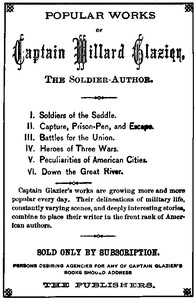
That afternoon, rain drummed the windows while Davis’s ironic vignettes of pacificos stayed with me—people caught between armies, their stories reduced to a reporter’s brief note. Later, the same quiet irony surfaced in Sword and Pen Ventures and Adventures of Willard Glazier — Text and Context, where adventure also brushes past suffering, the pen recording what the sword forgets.
A brief reflection can help important ideas stay with you longer.