About 757 minutes
The United States Since the Civil War — A Closer Reading
Modern Nations
174,010 recorded words. 8 minutes difference from this book's estimate.
View Gutenberg source #9868
The catalog record for Sword and Pen Ventures and Adventures of Willard Glazier — Text and Context provides practical reading context through 172,170 words, 12 hr 29 min estimated reading time, and 23 detected text sections.
The text analysis averages about 22.8 words per sentence, while the detected sections provide another way to judge how the source is divided.
Project Gutenberg metadata also associates the work with “United States -- History -- Civil War, 1861-1865 -- Personal narratives,” connecting these edition facts with the source record’s subject description.
Explore this collection
These alternatives are selected using recorded categories and estimated reading time.
About 757 minutes
Modern Nations
174,010 recorded words. 8 minutes difference from this book's estimate.
View Gutenberg source #9868About 786 minutes
Modern Nations
180,639 recorded words. 37 minutes difference from this book's estimate.
View Gutenberg source #40615About 684 minutes
Modern Nations
157,213 recorded words. 65 minutes difference from this book's estimate.
View Gutenberg source #29438Search stored excerpts and compare books → Choose by your preferences →
Choices use stored catalog measurements. Estimates vary with reading speed. A shared category is a catalog label, not a claim that two books have the same argument or literary quality.
Search reads excerpt text stored with this catalog and links to its associated Gutenberg record. The connection is stored in the site database; this tool does not recheck that every excerpt is word-for-word identical to that external record. Excerpt search does not cover every chapter and does not verify historical publication dates.
Catalog snapshot checked: 2026-09-26. Coverage: 99 public books, 99 available source excerpts.
Calculated from edition completeness, EPUB availability, text structure and catalogue metadata. Not a user rating.
Total of 100 points, scaled to a 2.5-5.0 range. Editions with an empty description or a missing EPUB file are not scored.
Public-domain source text
The source text is kept in the dedicated reader, separate from this catalogue record and its commentary.
The preface of Sword and Pen frames Willard Glazier as a “self-made man” whose career exemplifies “uncompromising duty,” “self-denial, perseverance and ‘pluck.’” Owens, the biographer, immediately establishes a dual identity for his subject: soldier and author. The title page’s full subtitle—listing Glazier’s “chequered life as a student and teacher,” his “unprecedented journey from ocean to ocean on horseback,” and his “discovery of the true source of the Mississippi River”—signals a narrative packed with varied exploits. The opening poem, contributed by a friend, declares that Glazier “wrote his name / First in war’s deeds, then slipping / His fingers off the sword, he found / The mightier pen more fitting.” This poetic summary sets up the book’s central claim: that Glazier’s transition from military action to literary production was a natural, even heroic progression.
The preface, written by Owens, does not merely introduce the book—it actively markets a particular image of Glazier. Owens asserts that “no apology will be required” for presenting episodes from the life of a self-made man, and he frames the narrative as a lesson for the young. The language is promotional: the story teaches “uncompromising duty,” “self-denial, perseverance and ‘pluck.’” The preface also claims that as a soldier, Glazier was “without fear and without reproach,” and as an author, he is “appreciated by his contemporaries.” This is not neutral biography; it is a deliberate construction of a heroic figure. The reader should note that the preface’s tone—earnest, moralizing, and boosterish—sets expectations for the chapters that follow. Owens is not a disinterested chronicler but an advocate, and the book’s structure will likely reinforce this celebratory stance.
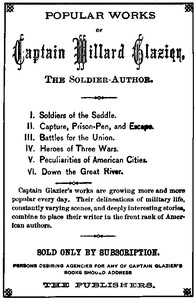
Chapter XXIX, “Battles for the Union,” presents extended excerpts from Glazier’s own book of the same title. Here, the reader encounters Glazier’s prose directly. In his preface to that work, Glazier states he aimed to present “in the most concise and simple form, the great contests in the war.” The excerpt on Bull Run illustrates this style: it opens with a sweeping statement that the field “will never lose their interest for the imaginative young or the patriotic old,” then lists the battles fought there—Bristoe, Groveton, Manassas, Centreville, Chantilly—and names commanders on both sides. The prose is factual, almost catalog-like, but it carries an emotional weight through phrases like “bones of more than forty thousand brave men” and “gigantic Roll of Honor.” The reader can observe how Glazier balances conciseness with a patriotic, elegiac tone. The excerpt also reveals his reliance on lists and proper nouns to establish authority and scope.
Owens frequently inserts press opinions to validate Glazier’s literary work. In Chapter XXIX, after introducing Battles for the Union, he lists newspapers—Philadelphia North American, Pittsburg Commercial, Chicago Inter-Ocean, and others—that have praised the book. This technique appears throughout the excerpts: the book’s success is measured not by critical analysis but by the quantity and prestige of its endorsements. For instance, Owens notes that 175,000 copies of an earlier work were sold and that it “has been a source of profound interest” to veterans. The reader should be aware that these testimonials are part of the book’s rhetorical strategy. They function as evidence of Glazier’s contemporary reputation, but they also reveal the biographical method: Owens builds his case through accumulation of external praise rather than through sustained analysis of Glazier’s character or writing.
The book’s subtitle prominently features Glazier’s “discovery of the true source of the Mississippi River,” and the Project Gutenberg transcriber’s note addresses this claim directly. It states that “as of 2008, the source of the Mississippi is considered to be Lake Itasca,” and that after an 1891 investigation, the stream from Elk Lake (which Glazier called Lake Glazier) was deemed “too insignificant.” The note even provides coordinates for both lakes. This editorial addition, while not part of Owens’s original text, is crucial for the modern reader. It highlights that Glazier’s discovery was contested and ultimately rejected by scientific consensus. The reader approaching Sword and Pen should keep this context in mind: the biography presents Glazier’s achievement as fact, but the historical record complicates that narrative. The book’s promotional tone may extend to this episode, and the reader should weigh Owens’s claims against external evidence.
Sword and Pen is best read as a period piece of heroic biography, where the author’s admiration for his subject shapes every page. The excerpts reveal a work that blends military history, personal anecdote, and literary self-promotion. Readers interested in Civil War memory, late-nineteenth-century publishing, or the construction of American manhood will find rich material here. Approach the book with an awareness of its promotional aims and its reliance on press testimonials; the narrative of Glazier’s life is as much a product of its era as it is a record of his deeds.
We who shelve books watch their quiet kinships grow. Glazier’s memoir, full of bright ambition and contested maps, shares that restless frontier spirit with A Letter from Major Robert Carmichael-Smyth to His Friend, the Author of 'The Clockmaker' — Context and Discussion, where a colonial dreamer chases his own stubborn notion of a railway west. Two voices, distinctly earnest, bound by the same hopeful, half-foolish certainty.
Use these questions to collect your thoughts before moving on.