About 416 minutes
The Champlain tercentenary — Text and Context
Modern Nations
95,670 recorded words. 6 minutes difference from this book's estimate.
View Gutenberg source #70842
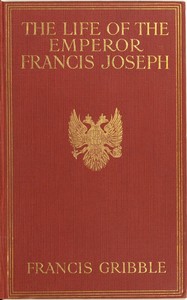
The life of the emperor Francis Joseph — Story, Setting & Ideas can be approached with a clearer sense of reading commitment from its source measurements: 96,970 words, 7 hr 2 min estimated reading time, and 53 detected text sections.
The text analysis averages about 28.6 words per sentence, while the detected sections provide another way to judge how the source is divided.
Project Gutenberg metadata also associates the work with “Franz Joseph I, Emperor of Austria, 1830-1916,” connecting these edition facts with the source record’s subject description.
Explore this collection
These alternatives are selected using recorded categories and estimated reading time.
About 416 minutes
Modern Nations
95,670 recorded words. 6 minutes difference from this book's estimate.
View Gutenberg source #70842About 429 minutes
Modern Nations
98,625 recorded words. 7 minutes difference from this book's estimate.
View Gutenberg source #34304About 414 minutes
Modern Nations
95,144 recorded words. 8 minutes difference from this book's estimate.
View Gutenberg source #18216Search stored excerpts and compare books → Choose by your preferences →
Choices use stored catalog measurements. Estimates vary with reading speed. A shared category is a catalog label, not a claim that two books have the same argument or literary quality.
Search reads excerpt text stored with this catalog and links to its associated Gutenberg record. The connection is stored in the site database; this tool does not recheck that every excerpt is word-for-word identical to that external record. Excerpt search does not cover every chapter and does not verify historical publication dates.
Catalog snapshot checked: 2026-09-26. Coverage: 99 public books, 99 available source excerpts.
Calculated from edition completeness, EPUB availability, text structure and catalogue metadata. Not a user rating.
Total of 100 points, scaled to a 2.5-5.0 range. Editions with an empty description or a missing EPUB file are not scored.
Public-domain source text
The source text is kept in the dedicated reader, separate from this catalogue record and its commentary.
Francis Gribble opens his 1914 biography of Francis Joseph with a methodological manifesto: previous writers, he claims, have treated court gossip and political history as separate realms, but in Austria they 'are continually meeting.' The book sets out to demonstrate that the Habsburg monarchy's survival depended on the personality of its ruler, a figurehead whose decisions mattered in a way those of constitutional monarchs did not. Gribble draws on memoirs by Countess Marie Larisch and Princess Louisa of Tuscany, as well as diplomatic accounts, to reconstruct a reign marked by intimate tragedies and dynastic crises.
Gribble explicitly positions his work against earlier studies. He praises Henry Wickham Steed's political survey and Sir Horace Rumbold's 'dutiful reticence,' but faults them for keeping 'tittle-tattle' and history apart. His own method is to show their intersection: the emperor's personal losses—his brother Maximilian's execution, his wife's assassination, the suicide of his son Rudolf at Mayerling—are treated not as mere anecdotes but as events that shaped policy. The preface frames the book as a corrective, arguing that Austria's 'medley of races' was unified only by loyalty to the Habsburg dynasty, making the sovereign's character a political force.
A long section on King Ludwig II of Bavaria illustrates Gribble's method. He quotes Countess Marie Larisch's contrast between Habsburg and Wittelsbach insanity—the former tending toward 'depravity, self-effacement, and common marriages,' the latter toward romantic excess—but immediately qualifies it, noting that 'common marriages' can be romantic and that Wittelsbachs also contracted them. The narrative then recounts Ludwig's broken engagement to Sophie, Elizabeth's sister, in novelistic detail: a staged photograph, a stolen ring, a smashed bust. Gribble presents this as a 'sufficient proof that his intelligence was none too strong,' yet he refrains from diagnosing madness, letting the actions speak.
Gribble's account of the intrigue against Ludwig's engagement hinges on a single piece of evidence: a photograph of Sophie with Count Holnstein, arranged by courtiers to suggest infidelity. The phrase 'the camera which cannot lie' appears in quotation marks, signaling Gribble's ironic distance. He notes that the ring supposedly given to Holnstein by Sophie had actually been stolen from her by an actress. The episode is told with a journalist's eye for detail—the bust, the torn portraits, the postponement—but Gribble never steps back to moralize. Instead, he lets the sequence of deceptions accumulate, showing how easily a weak king could be manipulated. The result is a portrait of court life as a theater of manufactured appearances.
Gribble structures his narrative around a series of catastrophes, each of which he calls a 'tragedy.' The execution of Maximilian forces Francis Joseph to 'humble himself to the Indians and half-breeds' to retrieve the body. The madness of Charlotte, Maximilian's widow, is described as 'stark, staring mad.' Ludwig's death is preceded by a debate over which dynasty is madder. Gribble's diction is blunt, even harsh: 'Ludwig was as mad as a hatter.' Yet he avoids clinical language, preferring the vocabulary of gossip and melodrama. This choice aligns with his stated aim: to show that in Austria, personal disaster and political crisis were inseparable, and that the emperor's life was a sequence of blows that tested the resilience of the monarchy itself.
Gribble's biography is best read as a hybrid: part political history, part court chronicle. Readers interested in the machinery of Habsburg rule will find the policy discussions thin; those seeking intimate detail will find the personal episodes vivid but selective. The book's value lies in its insistence that the two realms cannot be separated, and in the specific, often sardonic voice with which it tells its stories. Approach it as a contemporary document of how a British observer understood the Austro-Hungarian Empire on the eve of its dissolution.
Reading about Francis Joseph’s solitary endurance, I remembered my grandfather’s Civil War diary—his terse entries about mud and waiting. Some of My War Stories A Paper Read before the Ohio Commandery of the Loyal legion — Inside the Classic gave me that same quiet ache, the sense that history is mostly private endurance. Both books feel like lamps left burning in empty rooms.
Save your reaction, strongest insight, and memorable passage.