About 310 minutes
The chronicles of Enguerrand de Monstrelet, Vol. 12 [of 13] — A Reader’s Guide
Modern Nations
71,263 recorded words. 40 minutes difference from this book's estimate.
View Gutenberg source #65721
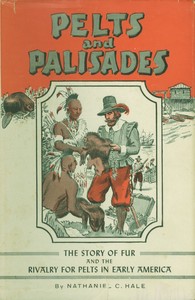
The source record for Pelts and palisades: The story of fur and the rivalry for pelts in early America — Themes and Context measures this digital text at 80,278 words, 5 hr 50 min estimated reading time, and 25 detected text sections.
The text analysis averages about 21.8 words per sentence, while the detected sections provide another way to judge how the source is divided.
Project Gutenberg metadata also associates the work with “United States -- History -- Colonial period, ca. 1600-1775,” connecting these edition facts with the source record’s subject description.
Explore this collection
These alternatives are selected using recorded categories and estimated reading time.
About 310 minutes
Modern Nations
71,263 recorded words. 40 minutes difference from this book's estimate.
View Gutenberg source #65721About 391 minutes
Modern Nations
89,830 recorded words. 41 minutes difference from this book's estimate.
View Gutenberg source #49095About 392 minutes
Modern Nations
90,145 recorded words. 42 minutes difference from this book's estimate.
View Gutenberg source #59741Search stored excerpts and compare books → Choose by your preferences →
Choices use stored catalog measurements. Estimates vary with reading speed. A shared category is a catalog label, not a claim that two books have the same argument or literary quality.
Search reads excerpt text stored with this catalog and links to its associated Gutenberg record. The connection is stored in the site database; this tool does not recheck that every excerpt is word-for-word identical to that external record. Excerpt search does not cover every chapter and does not verify historical publication dates.
Catalog snapshot checked: 2026-09-26. Coverage: 99 public books, 99 available source excerpts.
Calculated from edition completeness, EPUB availability, text structure and catalogue metadata. Not a user rating.
Total of 100 points, scaled to a 2.5-5.0 range. Editions with an empty description or a missing EPUB file are not scored.
Public-domain source text
The source text is kept in the dedicated reader, separate from this catalogue record and its commentary.
Nathaniel C. Hale opens Pelts and Palisades with a broad claim—"the story of fur is as old as the story of man"—then quickly narrows to the specific economic and imperial forces that shaped early America. The narrative voice is that of a military historian turned colonial scholar: precise, document-driven, and alert to strategy. Hale repeatedly cites letters, council records, and firsthand accounts, weaving them into a story where the fur trader, not the statesman, determines borders. The prose moves between sweeping assertions about mercantile energy and granular details of barter, shallop rentals, and Algonquin dialects. This is not a romantic wilderness tale but a business history with geopolitical stakes.
Hale writes as a compiler of evidence, not a storyteller. His sentences often begin with a source: "A detailed account of this competition was rendered by Thomas Dermer," or "They urged the company to undertake 'so certaine and gainefull' voyages." The effect is cumulative authority. He lets the documents speak, quoting phrases like "within our lymits" and "beinge in displeasure of my fryndes" to preserve the texture of seventeenth-century speech. Yet he also editorializes with dry understatement: "Almost—but not quite as challenging." This blend of archival fidelity and quiet judgment gives the narrative a steady, factual rhythm. Readers should expect frequent shifts between Hale's own analysis and the voices of colonists, traders, and company officials.
The book's pace mirrors the rivalry it describes: a slow accumulation of detail punctuated by moments of strategic urgency. Early chapters establish the European demand for beaver pelts and the legal framework of hat-making prohibitions. Then the tempo quickens as Hale tracks the movements of individual traders—Thomas Savage bartering on the Potomac, Henry Spelman renting shallops, Dutch ships appearing in the Delaware. The prose becomes more compressed when describing encroachments: "The Dutch interlopers on the coasts were almost as challenging to the Virginians... Almost—but not quite as challenging." This rhythmic repetition signals a turning point. Hale uses short paragraphs and abrupt transitions to convey the pressure of competition, then slows again for portraits of interpreters and runaways. The effect is a narrative that breathes with the trade itself.
Three motifs recur with precision. Language: Hale notes which traders knew Algonquin dialects, how they learned them (as hostages or cohabitants), and how this skill gave them advantage. Trade goods: He specifies what was bartered—"home-made shallops and less fancy trade goods" versus Dutch merchandise—and how resource constraints shaped colonial strategy. Geography: Rivers and bays are not backdrops but active agents. The "vast tidewater of the bay" and "great stretches of lake country" are described as territories to be reached before the French. These details are not decorative; they explain why certain traders succeeded and others failed. Hale's attention to the material conditions of the fur trade—the boats, the goods, the interpreters—grounds the geopolitical narrative in practical reality.
Hale's book rewards readers who attend to its documentary texture. The excerpts suggest a work that is less a continuous story than a mosaic of reports, letters, and council minutes. Pay attention to the dates and places named in each chapter; they map the shifting frontier of competition. The author's own voice is most audible in the gaps between quotations, where he weighs evidence or draws a quiet conclusion. This is a history built from the ground up, one shallop voyage at a time.
That rainy afternoon, Pelts and Palisades lingered on Henry Spelman’s uneasy days among strangers, his survival hinging on language and patience. The same quiet unease surfaced later, almost accidentally, in a regimental ledger of Massachusetts volunteers—names, nothing more, yet each one a boy far from home. I keep returning to that roster: Roster of Company I, 24th Regiment, Massachusetts Volunteers — Text and Context holds its own solemn gravity.
Build a private reading journal entry for this title.