About 391 minutes
The War of Quito — Edition Insights
Modern Nations
89,830 recorded words. 1 minutes difference from this book's estimate.
View Gutenberg source #49095
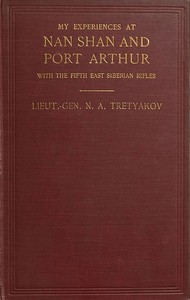
Before opening My Experiences at Nan Shan and Port Arthur with the Fifth East Siberian Rifles — A Closer Reading, the edition data offers a quick orientation: 90,145 words, 6 hr 32 min estimated reading time, and 19 detected text sections.
The text analysis averages about 22.1 words per sentence, while the detected sections provide another way to judge how the source is divided.
Project Gutenberg metadata also associates the work with “Russo-Japanese War, 1904-1905,” connecting these edition facts with the source record’s subject description.
Explore this collection
These alternatives are selected using recorded categories and estimated reading time.
About 391 minutes
Modern Nations
89,830 recorded words. 1 minutes difference from this book's estimate.
View Gutenberg source #49095About 399 minutes
Modern Nations
91,743 recorded words. 7 minutes difference from this book's estimate.
View Gutenberg source #61083About 404 minutes
Modern Nations
92,881 recorded words. 12 minutes difference from this book's estimate.
View Gutenberg source #70408Search stored excerpts and compare books → Choose by your preferences →
Choices use stored catalog measurements. Estimates vary with reading speed. A shared category is a catalog label, not a claim that two books have the same argument or literary quality.
Search reads excerpt text stored with this catalog and links to its associated Gutenberg record. The connection is stored in the site database; this tool does not recheck that every excerpt is word-for-word identical to that external record. Excerpt search does not cover every chapter and does not verify historical publication dates.
Catalog snapshot checked: 2026-09-26. Coverage: 99 public books, 99 available source excerpts.
Calculated from edition completeness, EPUB availability, text structure and catalogue metadata. Not a user rating.
Total of 100 points, scaled to a 2.5-5.0 range. Editions with an empty description or a missing EPUB file are not scored.
Public-domain source text
The source text is kept in the dedicated reader, separate from this catalogue record and its commentary.
Lieutenant-General N. A. Tretyakov's account of the Russo-Japanese War, originally serialized in the Russian military journal Voenny Sbornik in 1909, offers a regimental commander's perspective on the defense of Port Arthur. Translated by Lieutenant A. C. Alford, R.A., and edited by Captain F. Nolan Baker, R.A., the narrative is grounded in the daily realities of siege warfare: the scarcity of water on 203 Metre Hill, the nightly labor of fortifying rocky soil with inadequate tools, and the constant threat of enemy fire that made movement above ground a gamble. Tretyakov's voice is notably candid about his own fear—he admits to seeking safer cover during a bombardment, only to be trampled by men rushing with him—and his observations are precise, noting, for instance, that the Japanese expended over a hundred shells on a single hill in a departure from their usual daily allowance.
Tretyakov’s language is that of a professional soldier reporting to his peers. He uses precise military terminology—splinter-proofs, quick-firing guns, bomb-proof—but also slips into colloquial asides that reveal his state of mind. When he decides to change his position behind a traverse, he writes, “I put my idea into execution, but with unfortunate results.” The understatement is characteristic: a bruise on his back becomes a “memento of the occasion.” His descriptions of the enemy are matter-of-fact: the Japanese are “evidently preparing for something very important,” and their fire is measured in rounds per day. This restrained tone, however, does not mask the urgency. The phrase “we galloped off as hard as we could go” conveys haste without melodrama. The editor’s preface notes that the original articles were written in “simple and intimate language,” and that quality persists in translation: Tretyakov addresses his readers as fellow soldiers, assuming shared knowledge of siegecraft while still making the chaos comprehensible to outsiders.
Tretyakov rarely reproduces direct speech, but when he does, it serves as a marker of critical moments. The message from Major Stempnevski on 203 Metre Hill is summarized indirectly: “the enemy was sweeping the hill with artillery, and that the left flank of our trenches had suffered severely.” This indirect style reflects the formal chain of command; reports are filtered through the commander’s consciousness. Yet the urgency breaks through in the clipped syntax: “Namako Yama was also being heavily bombarded, and it was evident that an assault was imminent.” The absence of quotation marks around the major’s words suggests that Tretyakov is paraphrasing from memory, prioritizing content over exact wording. In contrast, his own internal dialogue appears as self-deprecating reflection: “It seemed to me that my position behind the traverse was not a particularly safe one.” This blend of reported orders and private thought gives the reader access to both the operational and the personal dimensions of command.
The narrative is organized chronologically but punctuated by recurring patterns: the daily cycle of night work and day concealment, the alternation of bombardment and lull, the movement of reinforcements between hills. Tretyakov describes how “the men only worked at night, as it would have been madness to do so in the daytime.” This structural repetition—night labor, dawn observation, afternoon shelling—creates a rhythm that mirrors the siege’s grinding monotony. He also notes the spatial organization of the defenses: the road running the length of the hill, the splinter-proofs made of planks, the battery for 6-inch guns. These details anchor the reader in a specific geography. The text’s movement between hills—from Fort Ta-yang-kou North to 203 Metre Hill to Namako Yama—follows the logic of a commander scanning his sector, not a historian summarizing a campaign. The result is a fragmented, episodic account that feels true to the fragmented experience of battle.
Three material details recur with insistence: the lack of water on 203 Metre Hill, the shortage of tools for digging, and the daily toll of killed and wounded. Tretyakov notes that water had to be carried up at night, and that “it was impossible for any one to show himself on the skyline.” The rocky soil and want of tools “hampered us greatly,” forcing men to work under cover of darkness. Casualties are reported with numerical precision: “every day we had several men killed there.” These details are not embellished; they are the raw data of survival. The author’s attention to logistics—ammunition scarcity, the number of companies on a hill, the placement of guns—reveals a commander’s preoccupation with resources. Even the enemy’s shell count is tracked: “instead of the usual daily allowance of two or three dozen shell, the Japanese had already expended more than a hundred rounds.” This quantitative eye gives the narrative a documentary weight that transcends personal memoir.
Tretyakov’s account is best read as a companion to operational histories of the siege, not as a substitute for them. He assumes the reader knows the broader campaign; his focus is the texture of regimental life under fire. The translation by Alford and editing by Baker preserve the original’s directness, though the reader should note that the English text occasionally smooths Russian military jargon into more familiar terms. For those interested in the human dimensions of siege warfare—the interplay of fear, duty, and physical exhaustion—this narrative offers a rare, unvarnished view from a commander who does not spare himself.
There’s something about these old siege accounts that lingers, the way a quiet room does after a story ends. That colonel’s weariness under the bombardment stayed with me, much like the lingering ache of the Galveston narratives—different disasters, same human weight. I keep returning to both, not for answers, but for the company. The Complete Story of the Galveston Horror — A Reader’s Guide sits beside it now, a strange, somber pair.
Answer a few questions and save a private reflection on this device.