About 399 minutes
The Assault on Mount Everest, 1922 — Themes and Context
Modern Nations
91,743 recorded words. 5 minutes difference from this book's estimate.
View Gutenberg source #61083
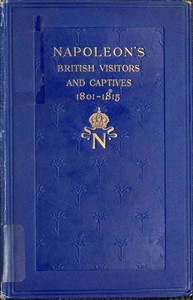
For Napoleon's British visitors and captives, 1801-1815 — Key Ideas to Explore, the stored edition analysis reports 92,881 words, 6 hr 44 min estimated reading time, and 18 detected text sections.
The text analysis averages about 17.1 words per sentence, while the detected sections provide another way to judge how the source is divided.
Project Gutenberg metadata also associates the work with “France -- History -- Consulate and First Empire, 1799-1815,” connecting these edition facts with the source record’s subject description.
Explore this collection
These alternatives are selected using recorded categories and estimated reading time.
About 399 minutes
Modern Nations
91,743 recorded words. 5 minutes difference from this book's estimate.
View Gutenberg source #61083About 414 minutes
Modern Nations
95,144 recorded words. 10 minutes difference from this book's estimate.
View Gutenberg source #18216About 392 minutes
Modern Nations
90,145 recorded words. 12 minutes difference from this book's estimate.
View Gutenberg source #59741Search stored excerpts and compare books → Choose by your preferences →
Choices use stored catalog measurements. Estimates vary with reading speed. A shared category is a catalog label, not a claim that two books have the same argument or literary quality.
Search reads excerpt text stored with this catalog and links to its associated Gutenberg record. The connection is stored in the site database; this tool does not recheck that every excerpt is word-for-word identical to that external record. Excerpt search does not cover every chapter and does not verify historical publication dates.
Catalog snapshot checked: 2026-09-26. Coverage: 99 public books, 99 available source excerpts.
Calculated from edition completeness, EPUB availability, text structure and catalogue metadata. Not a user rating.
Total of 100 points, scaled to a 2.5-5.0 range. Editions with an empty description or a missing EPUB file are not scored.
Public-domain source text
The source text is kept in the dedicated reader, separate from this catalogue record and its commentary.
John Goldworth Alger’s Napoleon’s British Visitors and Captives, 1801–1815 opens with a striking claim: that the French Revolution and Napoleonic Empire made France ‘the focus of political and social life’ as never before. The book’s method is to test that claim by tracing the movements of hundreds of British subjects—tourists, diplomats, prisoners, and long-term residents—through a period of shifting borders and sudden hostilities. Alger draws on police registers, embassy dispatches, and personal letters, often letting the documents speak in their own clipped, bureaucratic language. The result is a study less of grand strategy than of individual predicaments: the chess parties of a wealthy expatriate, the robbery of a jewelled casket during a whist game, the pistols brandished at a servant’s door. These details accumulate into a portrait of a society where protection from Talleyrand could matter more than a passport.
Alger’s prose is studded with the vocabulary of suspicion. Police reports are quoted verbatim: a spy notes that Quintin Craufurd, though ‘blasé,’ may still be dangerous because of ‘Madame Sullivan, that foreigner of easy virtue.’ The phrase ‘easy virtue’ is not Alger’s judgment but a transcription of official suspicion. Elsewhere, the author records that Americans ‘were liable to be arrested as English, for the latter sometimes attempted to pass themselves off as Americans.’ The sentence is flat, factual, and revealing: identity itself became a negotiable category under surveillance. Alger’s own diction tends toward the understated—‘unmolested,’ ‘allowed full liberty’—which throws the more dramatic episodes into relief. When Sir James Craufurd ‘flourished pistols in the faces of two servants and forced his way in,’ the violence is reported without embellishment, as if the archive itself had grown weary of scandal.
Alger rarely invents dialogue; instead, he reproduces fragments from letters, memoirs, and legal proceedings. Madame de Genlis’s letter about the robbery at Madame de Talleyrand’s is given in full: ‘That poor Mr. Craufurd was robbed yesterday while he was playing whist… All his superb jewels, caskets, rings, gold medals, 300 louis d’or, etc.’ The specificity of the list—the gold medals, the exact number of louis—anchors the anecdote in material reality. Elsewhere, a court case yields reported speech: Sir James Craufurd ‘charged the servants with assaulting him, but this, like the other accusations, was dismissed.’ The passive construction (‘was dismissed’) mirrors the legal outcome, while the repeated ‘this’ suggests a weary catalogue of failed suits. Alger’s method is to let such voices accumulate, trusting the reader to hear the difference between a diplomat’s measured complaint and a blackmailer’s bluster.
The book’s table of contents reads like a bureaucratic ledger: ‘Visitors,’ ‘Amusements and Impressions,’ ‘Captivity,’ ‘Two Restorations.’ Within chapters, Alger proceeds by category—‘M.P.’s,’ ‘Peers and their Families,’ ‘Soldiers,’ ‘Sailors’—as if sorting index cards. This structure mirrors the police registers he consulted, where individuals were filed by nationality, rank, and suspected loyalty. Yet the catalogue yields unexpected stories. Under ‘Claimants and Men of Business,’ we find the Craufurd affair, with its bigamy accusations and libel trials. Under ‘Amusements,’ a chess party becomes the occasion for a theft. The taxonomic frame does not flatten the material; it allows Alger to move from general observation (‘never before or since was France so much the focus’) to specific case, then back again. The effect is cumulative: the reader begins to see patterns of privilege and peril that cut across the official categories.
Certain objects recur with the insistence of motifs. Jewels appear in the Craufurd robbery—‘superb jewels, caskets, rings’—and again in the inventory of a widow’s possessions. Pistols surface when Sir James forces his way into his uncle’s house, and later when he ‘flourishes’ them at servants. Passports, or their absence, determine who may travel and who must stay. Alger notes that Fraser Frisell, who had lived in France since 1792, was ‘allowed full liberty’—the phrase implying that liberty was a privilege granted by the state, not a right. The detail of the ‘hole cut in the shutter’ during the robbery is forensic, almost novelistic. These recurring physical details—the louis d’or, the forced window, the desk ‘forced’ open—ground the narrative in tangible evidence. They also hint at a world where property and person were never entirely secure, even for the well-connected.
Alger’s book is best read as a mosaic of primary sources rather than a continuous argument. The reader should attend to the footnotes and quoted documents, where the author’s own voice recedes and the archive speaks. Because the excerpts are incomplete, some episodes—like the fate of Quintin Craufurd’s compensation claim—remain unresolved. But that incompleteness is itself instructive: it mirrors the fragmentary record left by a regime that both attracted and entrapped its foreign guests.
Reading about those British travellers trapped in Napoleonic France, their fates twisted by rank and rumour, I found myself recalling a quieter sort of fortitude. The same unyielding human drive to press onward, despite maps that lied and winters that bit hard, lingers in the old accounts of the Northwest. It made me think of Pathfinders of the West Being the Thrilling Story of the Adventures of the Men Who Discovered the Great Northwest: Radisson, La Vérendrye, Lewis and Clark — Reading Notes, and how every journey, even across a continent, begins with a simple step into the unknown.
Answer a few questions and save a private reflection on this device.