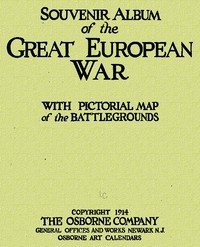
Souvenir Album of the Great European War With Pictorial Maps of the Battlegrounds — Background and Themes

(0 User reviews)   1163
In Category - World Events
Anonymous Project Gutenberg 2014 Not confirmed
World War, 1914-1918 -- Pictorial works Readers of public-domain and historical texts
Project Gutenberg digital edition en

Edition facts

Words 8,150
Reading time 36 min
Text sections 2

Before opening Souvenir Album of the Great European War With Pictorial Maps of the Battlegrounds — Background and Themes, the edition data offers a quick orientation: 8,150 words, 36 min estimated reading time, and 2 detected text sections.

The text analysis averages about 20.0 words per sentence, while the detected sections provide another way to judge how the source is divided.

Project Gutenberg metadata also associates the work with “World War, 1914-1918 -- Pictorial works,” connecting these edition facts with the source record’s subject description.

An analysis of the anonymous 1914 souvenir album's authorial choices in diction, dialogue, and description, focusing on how captions and maps frame the war through commercial, patriotic, and ethnographic lenses.
Share
Editorial Edition Score 4.5/5

Calculated from edition completeness, EPUB availability, text structure and catalogue metadata. Not a user rating.

How this score is calculated
  • Description quality20 pts
  • Title & short description10 pts
  • Source metadata20 pts
  • Text length15 pts
  • Chapters / structure15 pts
  • EPUB file integrity20 pts

Total of 100 points, scaled to a 2.5-5.0 range. Editions with an empty description or a missing EPUB file are not scored.

Edition quality

Read the Text

ons were originally trained to fight either on horseback or afoot. Many of them carry bamboo lances, said to be even stronger than steel. The term "dragoon" probably comes from the dragon worked on the muzzle of the old carbine they used to carry, as dragons were supposed to spout fire. The bivouac on piles of straw, with weapons stacked ready for instant service, suggests vividly the condition of soldiers in the intervals of hard fighting. This is an actual scene on the line of retreat toward Paris.

German Field Artillery

The splendid "fitness" of the German artilleryman is illustrated by these vigorous, intelligent fellows, smiling at the photographer as he snapped them. They might be riding to a picnic, instead of to awful war. Their helmets are tipped with a brass ball instead of a spike such as the infantry have, in order that the eyes may not be injured when the men bend over the guns to aim them. The box, or caisson, on which two men are sitting, contains projectiles and equipment for use in serving the gun.

The Famous 75 Millimeter French Guns at the Marne

The French guns, by many military experts, are said to be superior to any other field artillery. Their bore is only 2.95 inches, but the initial velocity and accuracy are greater than the German guns, and their lightness makes them more mobile in action. A battery has about the same effect on an advancing line as a mowing-machine on a harvest field.

French Hussars at Rouen

The Hussars are light cavalry intended for scouting, and use much smaller horses than the cuirassiers. Many French race-horses were seized by the government for the use of these troops, and a maximum price of $200 was paid, though some of the thoroughbreds were valued at $10,000 by their owners.

In the background are seen the towers of the cathedral at Rouen, which is a quaint, old Norman town, the capital of William the Conqueror, before he crossed the Channel.

French Line Infantry Passing Monument of Napoleon

The monument is near the village of Vauchamps, where the French defeated Blucher and the Prussians on February 14, 1814. It is in the Department of the Marne: scene of the first victory of the allies in the present war.

Red caps and trousers have been the uniform of French soldiers since Napoleon's day, but they provide the enemy with a good target, and are poorly suited to modern campaigning. The Germans, however, gave France no time to equip her army with khaki, and the French soldiers took the field in their historic garb.

This variety of light cavalry was introduced into central Europe by the Tartars of Asia in the middle ages. They were armed with sabre, pistol and lance, at first carried in the left hand. The pennon is intended to frighten the enemy's horses, and identifies the men as Prussians. The Poles, Austrians, and Russians also adopted uhlans. In the Franco-Prussian War of 1870 they led the invasion of northern France, and won great fame by their fearless activity.

Feeding the Men in the Trenches--A German Field Bakery

Napoleon said "An army travels on its stomach." This is part of the wonderful German organization for supplying the men in the field with daily bread. Each wagon supplies 1,600 men--there are twenty-five with each army corps of 40,000. The war ration includes bread, biscuit, eggs, meat, beans, rice, dried vegetables, salt and coffee.

The German Defense Against the Airship--Krupp Gun on Motor

This is one of the deadly Krupp aeroplane guns, mounted on a Mercedes auto truck. The rear wheels are braced to steady the gun from vibration under the heavy shock of firing.

An aeroplane is a very difficult target, not only on account of its rapid flight, but also because the only vital spots are the engine and the passengers.

Crack Austrian Regiment from Vienna

Austrian military traditions are equal to any in Europe. In the sixteenth century they turned back the tide of Turkish conquest and saved Europe. Military service is compulsory on all able-bodied males from 20 to 42, and totals twelve years--three in the line, seven in reserve, and two in the "Landwehr." The long trousers worn by these troops show that they are recruited from the Germanic part of the empire--for the Austrian army, like the empire itself, contains men speaking twenty-six different languages.

Cossacks--The Rough Riders of Russia

The Cossacks of the river Don pay no taxes, but are liable to military service from eighteen to fifty, and each must furnish his own horse. They are wonderful riders, and excellent scouts or skirmishers. Their hollow circle formation is a favorite one for defense.

The anonymous compilers of this 1914 souvenir album frame the Great War through a commercial lens: the introduction presents the photographs as a gift to customers, noting they were originally postcards. This origin shapes the album's tone—celebratory, patriotic, and visually striking, with captions that blend factual description with national stereotypes. The pictorial maps and colorized photos aim for preservation, but the text reveals a specific editorial voice that simplifies complex geopolitics into digestible, often biased, narratives.

Diction of National Character

The album's captions employ a consistent diction that assigns fixed traits to each nation. French troops are described with terms like "impetuous" and "hardiest," while German soldiers are linked to "industrial" and "commercial development." The description of Algerian Turcos emphasizes their "trick of 'playing possum'"—a phrase that exoticizes and subtly denigrates their tactics. This language reduces complex armies to caricatures, reflecting the era's racial and national stereotypes. The choice of words like "terrible" for the Turcos and "sharp shooters" for French alpine troops reveals a hierarchy of martial virtues, with European soldiers framed as disciplined and colonial troops as unpredictable.

Visual and Verbal Framing of Combat

The captions often explain the photographs by providing tactical context, but they avoid graphic descriptions of violence. For instance, the image of French cuirassiers helping a wounded comrade is accompanied by a note on their historical equipment—"steel cuirasses and helmets with horsehair plumes"—rather than the injury itself. This choice prioritizes pageantry over pain, aligning with the album's souvenir purpose. Similarly, the mention of Turcos "springing up and striking from the rear" is presented as a clever tactic, not a brutal act. The verbal framing sanitizes war, turning it into a spectacle of national character and military technology.

Geopolitical Simplification in the Maps

The pictorial maps and accompanying country profiles distill complex alliances into clear motivations: Austria seeks Mediterranean access, Germany wants maritime power, Russia eyes Constantinople. The text uses declarative sentences—"Austria possesses important ports on the Adriatic"—that present strategic interests as self-evident. The maps likely reinforce this by visually highlighting borders and resources. However, the excerpts lack detail on the maps themselves, so inference is limited. The compilers' choice to include such profiles suggests an intent to educate a domestic audience, framing the war as a clash of imperial ambitions rather than a tragedy.

The Anonymous Voice and Its Implications

The album's anonymity is itself a notable authorial choice. Without a named author, the text adopts a corporate, authoritative tone—"Believing that these photographs... possess a world wide interest"—that masks individual perspective. This voice lends an air of objectivity, yet the captions are rife with subjective judgments. The introduction's direct address to "our customers" positions the reader as a recipient of a gift, encouraging uncritical appreciation. The lack of attribution also means no single viewpoint can be challenged, making the album a product of its commercial and patriotic context rather than a personal account.

Readers should approach this album as a curated artifact of wartime propaganda, not a neutral record. The interplay of image and caption reveals how commercial interests and national pride shaped early representations of the conflict. Noting the diction and omissions—such as the absence of civilian suffering—offers insight into the era's selective memory. This edition preserves a snapshot of how the war was packaged for American audiences in 1914.

Holding this album, I remembered my grandfather’s worn atlas, its margins penciled with names I couldn’t pronounce. Those maps felt as distant as these captions’ cheery patriotism. Later, Defenders of Democracy — A Closer Reading offered a similar hush, showing how another era’s earnest words could blur a war’s ragged edges into a tidy, saleable story. We don’t inherit the trenches, only their souvenirs.

There are no reviews for this eBook.

0
0 out of 5 (0 User reviews )

Add a Review

Your Rating *
There are no comments for this eBook.

Reader reflection

Your personal reading reflection

Build a private reading journal entry for this title.

Your progress 0 / 10
1

Where are you in your reading?

2

How did the book work for you overall?

3

Would you pass this book on to a friend?

4

How demanding did the text feel?

Related eBooks