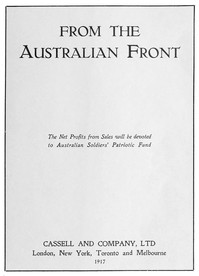
From the Australian Front presents a sequence of photographs taken by official photographers—Capt. F. Hurley, Lieut. E. Brooks, Lieut. H. F. Baldwin, and Lieut. G. H. Wilkins—documenting the Australian Imperial Force in France and Flanders during 1916–1917. The book opens with a short introduction dated September 28, 1917, framing the collection as a Christmas gift to those at home, intended to convey “some idea of our surroundings on the battle fronts.” The images move from training grounds and billets to the devastated landscape of Pozières, where “a few walls and rafters were then remaining.” A recurring visual motif is the contrast between peaceful rural scenes—a farm, summer flowers, a cook-house—and the wreckage of war, a juxtaposition that shapes the reader’s experience of the front.
Structure: From Billets to Battlefields
The book’s arrangement follows a chronological and geographical arc, beginning with early training in Flanders—a “Bomb School,” an estaminet reached by jumping out of a communication trench—then moving to the “Peaceful Line,” where trenches run “amongst the Summer Flowers.” This calm is deliberately broken by the entry on Pozières, the site of a costly Australian attack on July 23, 1916. The captions anchor each image to a specific place and moment, creating a documentary rhythm: the reader sees the build-up, the ordinary routines of camp life, and then the shattered village. The final pages include a poem, “The Rum Ration,” by W. L. King of the 60th Battalion, which shifts the tone from visual record to personal reflection. This structural movement—from preparation to combat to aftermath—gives the collection a narrative shape without explicit commentary.
Recurring Images: The Everyday and the Devastated
Several visual patterns recur across the photographs. The “Peaceful Line” appears multiple times: a cook-house, a dug-out, a snapshot of General Birdwood and his Chief of Staff at the Abbey de Bertin. These images emphasize the mundane infrastructure of war—billets, farms, bomb schools—as much as the front itself. In contrast, the Pozières sequence shows only rubble: “a few walls and rafters were then remaining.” The caption for No-Man’s-Land in the Peaceful Line notes that it was “across exactly such a spot, but wider, that the Australians charged when first they entered heavy fighting in France before Fromelles, on July 19, 1916.” This linking of a peaceful-looking field to a specific, violent event is a key technique: the photographs do not show the charge, but the caption forces the reader to imagine it.
Movement Between Scenes: The Reader as Traveller
The captions frequently describe movement: “The Arrival in Flanders,” “One of the Earliest Battalions to enter the Trenches in France,” “The Chalk-pit past which they approached.” This language positions the reader as a traveller moving through the theatre of war. The introduction reinforces this by addressing the book as a means to “convey to those whom we left behind in Australia … some idea of our surroundings.” The photographs are not static; they imply a journey from home to the front, from safety to danger. The final image of the “Rum Ration” poem, with its line “WHO IS THERE WHERE IS MY BOY TONIGHT,” brings the reader back to the emotional distance between soldier and family, completing the circular movement from departure to longing.
The Role of Captions and the Anonymous Author
The book is published anonymously, with profits going to the Australian Soldiers’ Patriotic Fund. The captions are terse and factual, yet they carry implicit judgments: the “Peaceful Line” is ironic, given that it is a trench system; the description of Pozières as “taken” after midnight on July 23 is starkly matter-of-fact. The introduction, signed from France, thanks “all for their past work” and sends “best of good wishes to every member of the A.I.F.” This framing gives the collection the feel of an official unit souvenir rather than a personal memoir. The captions do not name individual soldiers or describe emotions; they record locations, dates, and events. This restraint leaves the photographs to speak for themselves, while the brief text anchors them in a shared experience of the AIF.
Readers should approach From the Australian Front as a curated visual document, not a continuous narrative. The gaps between images—what is not shown—are as significant as what is. The book’s value lies in its accumulation of small, specific details: a farm in Flanders, a chalk-pit, a winter snapshot. Pay attention to the captions’ dates and place names; they map the AIF’s movements across France. The final poem offers a rare personal voice, but the photographs remain the primary record, inviting the reader to look closely at the ordinary landscapes of war.
Flipping through From the Australian Front, I paused on a photo of soldiers grinning in the mud, and it reminded me of my grandfather’s tin trunk—his war, never spoken, only hinted at in sepia. Reading about the hidden nets and mystery ships in Submarine Warfare of To-day How the Submarine Menace Was Met and Vanquished, with Descriptions of the Inventions and Devices Used, Fast Boats, Mystery Ships, Nets — Background and Themes gave me that same hush—the quiet ingenuity beneath terrible noise, a world held together by small, stubborn hands.