About 36 minutes
Souvenir Album of the Great European War With Pictorial Maps of the Battlegrounds — Background and Themes
World Events
8,150 recorded words. 1 minutes difference from this book's estimate.
View Gutenberg source #46822
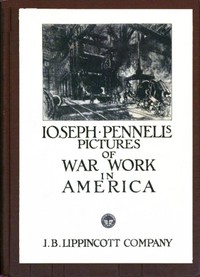
Before opening Joseph Pennell's Pictures of War Work in America Reproductions of a series of lithographs of munition works made by him with the permission and authority of the United — Themes and Context, the edition data offers a quick orientation: 7,847 words, 35 min estimated reading time, and 2 detected text sections.
The text analysis averages about 25.9 words per sentence, while the detected sections provide another way to judge how the source is divided.
Project Gutenberg metadata also associates the work with “World War, 1914-1918 -- Pictorial works,” connecting these edition facts with the source record’s subject description.
Explore this collection
These alternatives are selected using recorded categories and estimated reading time.
About 36 minutes
World Events
8,150 recorded words. 1 minutes difference from this book's estimate.
View Gutenberg source #46822About 24 minutes
World Events
5,394 recorded words. 11 minutes difference from this book's estimate.
View Gutenberg source #47737About 55 minutes
World Events
12,493 recorded words. 20 minutes difference from this book's estimate.
View Gutenberg source #50788Search stored excerpts and compare books → Choose by your preferences →
Choices use stored catalog measurements. Estimates vary with reading speed. A shared category is a catalog label, not a claim that two books have the same argument or literary quality.
Search reads excerpt text stored with this catalog and links to its associated Gutenberg record. The connection is stored in the site database; this tool does not recheck that every excerpt is word-for-word identical to that external record. Excerpt search does not cover every chapter and does not verify historical publication dates.
Catalog snapshot checked: 2026-09-26. Coverage: 99 public books, 99 available source excerpts.
Calculated from edition completeness, EPUB availability, text structure and catalogue metadata. Not a user rating.
Total of 100 points, scaled to a 2.5-5.0 range. Editions with an empty description or a missing EPUB file are not scored.
Public-domain source text
The source text is kept in the dedicated reader, separate from this catalogue record and its commentary.
Joseph Pennell's Pictures of War Work in America reproduces a series of lithographs he made inside United States munitions factories during World War I, with permission from the government. The book pairs each plate with a brief note by the artist, who also provides an introduction. Pennell, already known for his earlier volumes on war work in England and the Panama Canal, here turns his attention to American industrial might. The plates emphasize scale—'the biggest hammer in the world,' 'the biggest lathe in the world'—and the dramatic contrasts of light and shadow in these vast, windowless sheds. Pennell's notes record not only technical details but also the voices of workers, whose comments range from puzzled questions about his hand-drawing methods to wry jokes about avoiding the draft.
Pennell repeatedly selects subjects that are 'the biggest in the world,' and his notes make clear that this is a deliberate artistic choice. The lithographs emphasize the overwhelming size of machinery and buildings: a gun pit described as 'towering, windowless, sombre without, very spacious within,' or a lathe that dwarfs the men who operate it. Yet the human element is never absent. Workers appear in the notes as speaking characters, not mere figures. A man asks Pennell why he does not use a machine; another calls him 'Dad' and then 'Fatty.' The artist records these exchanges with evident amusement, and they provide a counterpoint to the sublime industrial landscapes. The tension between the inhuman scale of the machinery and the very human reactions of the workers gives the book its particular character.
Pennell's notes frequently point out contrasts between old and new, dark and bright. In one shell factory, he remarks on 'the contrast between the dark old shop and bright new one.' The gun pits are described as filled with 'strong shadows and strange shapes,' while other shops are open and airy. These contrasts are not merely visual; they also reflect the rapid industrialization of war production. Pennell draws attention to the way each plant 'puts big character into its products,' noting that one gun pit works deep underground while another operates high above. The lithographs themselves, reproduced in black and white, rely on these tonal differences to create drama. Readers should pay attention to how Pennell uses darkness and light to guide the eye through the composition, often leaving large areas of shadow that suggest the immensity of the spaces.
Pennell's notes reveal his own role in the factories as both observer and subject of curiosity. Workers ask him what newspaper his drawings will appear in, or whether he is allowed to use a machine. The artist loses his temper at a precocious apprentice, then is mollified by a peacemaker. These vignettes show Pennell as a visible, sometimes awkward presence. He also records moments of cooperation: a manager brings a gun to pose as a model, and Pennell reflects that he finds 'my studio and my models wherever I work.' The introduction, titled 'My Lithograph,' further emphasizes the personal nature of the project. The book is not a detached documentary but a record of one artist's encounter with the industrial war effort, complete with the frictions and pleasures of that encounter.
Pennell's notes are rich with the vernacular speech of the factory floor. A worker explains that he would 'sooner waste my time makin' guns, than spend it havin' 'em shot at me by some Dutchman.' Another, asked why he does not clean a pit, retorts, 'Well, Sammie, if you want to know why, you go down an' find out for yourself.' These exchanges are not merely decorative; they give a sense of the social atmosphere in which Pennell worked. The men are skeptical, funny, and sometimes complimentary. One says, 'Say, wot paper's it comin' out in—I'll buy that paper,' which Pennell calls 'a compliment.' The artist also notes that Black workers 'saw more in my drawings than the white,' a remark that stands out in a text otherwise focused on machinery. These voices prevent the book from becoming a purely aesthetic exercise and root it in the lived reality of wartime labor.
Readers approaching this book should consider it as a collaboration between the artist and the industrial landscape he depicts. Pennell's lithographs are not neutral records; they are shaped by his eye for the dramatic and his interest in scale. The notes, though brief, add a layer of anecdote and personality that enriches the plates. For those interested in the visual culture of World War I, or in the intersection of art and industry, this volume offers a focused, personal view of American munitions production at a critical moment.
There’s something humbling in Pennell’s vast, smoky factories—ordinary people swallowed by enormous work. It reminded me, oddly, of another kind of endurance, the quieter one in The Story of a Siberian Exile; Followed by a Narrative of Recent Events in Poland — Reading Notes, where survival isn’t heroic, just stubbornly human. Both leave you staring at what people bear, and how slowly they tell it afterward.
Your answers remain private and are stored only in this browser.