About 36 minutes
Souvenir Album of the Great European War With Pictorial Maps of the Battlegrounds — Background and Themes
World Events
8,150 recorded words. 19 minutes difference from this book's estimate.
View Gutenberg source #46822
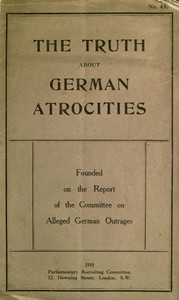
The source record for The Truth About German Atrocities Founded on the Report of the Committee on Alleged German Outrages — A Reader’s Guide measures this digital text at 12,493 words, 55 min estimated reading time, and 2 detected text sections.
The text analysis averages about 19.6 words per sentence, while the detected sections provide another way to judge how the source is divided.
Project Gutenberg metadata also associates the work with “World War, 1914-1918 -- Atrocities,” connecting these edition facts with the source record’s subject description.
Explore this collection
These alternatives are selected using recorded categories and estimated reading time.
About 36 minutes
World Events
8,150 recorded words. 19 minutes difference from this book's estimate.
View Gutenberg source #46822About 35 minutes
World Events
7,847 recorded words. 20 minutes difference from this book's estimate.
View Gutenberg source #48923About 76 minutes
World Events
17,344 recorded words. 21 minutes difference from this book's estimate.
View Gutenberg source #40905Search stored excerpts and compare books → Choose by your preferences →
Choices use stored catalog measurements. Estimates vary with reading speed. A shared category is a catalog label, not a claim that two books have the same argument or literary quality.
Search reads excerpt text stored with this catalog and links to its associated Gutenberg record. The connection is stored in the site database; this tool does not recheck that every excerpt is word-for-word identical to that external record. Excerpt search does not cover every chapter and does not verify historical publication dates.
Catalog snapshot checked: 2026-09-26. Coverage: 99 public books, 99 available source excerpts.
Calculated from edition completeness, EPUB availability, text structure and catalogue metadata. Not a user rating.
Total of 100 points, scaled to a 2.5-5.0 range. Editions with an empty description or a missing EPUB file are not scored.
Public-domain source text
The source text is kept in the dedicated reader, separate from this catalogue record and its commentary.
The pamphlet opens by framing the invasion of Belgium as a breach of treaty, then moves abruptly into a catalogue of specific incidents. Its structure is driven by categories of victims—civilians, women, children, the aged—rather than by chronology or geography. Each section collects depositions from different towns, creating a mosaic of recurring details: bodies in streets, forced labor, and the use of civilians as screens. The effect is cumulative, with the same patterns surfacing in Louvain, Dinant, and Malines.
The pamphlet’s organizing principle is the type of victim, not the sequence of events. After an introduction that recounts Germany’s broken assurances, the text divides into sections: civilians murdered, women outraged, children killed, the aged and infirm brutalized. Within each, evidence is presented as a series of short, location-tagged statements. For example, the section on women includes reports from Dinant, Gelrode, and Hofstade, each describing a specific act—a woman shot at 100 yards, another with her breasts cut off. This structure prioritizes the nature of the crime over narrative flow, turning the pamphlet into a reference document.
Certain images recur across multiple entries. Corpses of women in streets appear in Tamines and Malines. The mutilation of breasts is mentioned in both Hofstade and Malines. Children are killed in carts, on village greens, and at farmhouse doors. One deposition describes a child nailed to a door by hands and feet—a detail the committee acknowledges as “almost incredible” but accepts. These repeated motifs, drawn from different witnesses and locations, create a pattern that the pamphlet uses to argue for the credibility of the reports.
The text shifts rapidly from one town to another, often within a single paragraph. A witness in Haecht describes a child nailed to a door; the next sentence moves to Capelle-au-Bois, where two children are murdered in a cart. This jump-cut technique mirrors the chaos of the invasion and emphasizes the widespread nature of the events. The pamphlet does not linger on any single location but instead builds a composite picture through accumulation. The effect is disorienting, as the reader is moved from street to street without transition.
The pamphlet is not a firsthand account but a summary of depositions collected by the Committee on Alleged German Outrages, chaired by Lord Bryce. The text frequently interjects with the committee’s own judgments: “There can be no possible defence for the murder of children” or “the evidence for which we feel bound to accept.” These statements frame the depositions as verified facts. The pamphlet’s structure—first presenting the evidence, then the committee’s findings—reinforces this authority. The final section, “Findings of the Committee,” condenses the earlier catalog into a formal verdict.
Readers should approach this pamphlet as a curated selection of evidence, not a comprehensive history. The committee’s role as intermediary means that the voices of witnesses are filtered through a legalistic lens. Pay attention to how the text uses repetition and location tags to build a case. The pamphlet is a document of its time, shaped by the need to justify war and to counter German denials.
Decades of shelving have taught me that some books whisper across the stacks. The 1915 pamphlet's careful cataloging of sorrow—each victim, each village—finds a strange echo in the steady, unflinching gaze of Action Front — Edition Insights. They share a quiet, solemn patience, holding grief in clear prose, letting silence speak its own testimony.
Your answers remain private and are stored only in this browser.