About 55 minutes
The Truth About German Atrocities Founded on the Report of the Committee on Alleged German Outrages — A Reader’s Guide
World Events
12,493 recorded words. 21 minutes difference from this book's estimate.
View Gutenberg source #50788
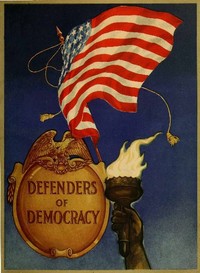
For Defenders of Democracy — A Closer Reading, the stored edition analysis reports 17,344 words, 1 hr 16 min estimated reading time, and 4 detected text sections.
The text analysis averages about 14.2 words per sentence, while the detected sections provide another way to judge how the source is divided.
Project Gutenberg metadata also associates the work with “World War, 1914-1918 -- Alabama,” connecting these edition facts with the source record’s subject description.
Explore this collection
These alternatives are selected using recorded categories and estimated reading time.
About 55 minutes
World Events
12,493 recorded words. 21 minutes difference from this book's estimate.
View Gutenberg source #50788About 108 minutes
World Events
24,717 recorded words. 32 minutes difference from this book's estimate.
View Gutenberg source #10145About 36 minutes
World Events
8,150 recorded words. 40 minutes difference from this book's estimate.
View Gutenberg source #46822Search stored excerpts and compare books → Choose by your preferences →
Choices use stored catalog measurements. Estimates vary with reading speed. A shared category is a catalog label, not a claim that two books have the same argument or literary quality.
Search reads excerpt text stored with this catalog and links to its associated Gutenberg record. The connection is stored in the site database; this tool does not recheck that every excerpt is word-for-word identical to that external record. Excerpt search does not cover every chapter and does not verify historical publication dates.
Catalog snapshot checked: 2026-09-26. Coverage: 99 public books, 99 available source excerpts.
Calculated from edition completeness, EPUB availability, text structure and catalogue metadata. Not a user rating.
Total of 100 points, scaled to a 2.5-5.0 range. Editions with an empty description or a missing EPUB file are not scored.
Public-domain source text
The source text is kept in the dedicated reader, separate from this catalogue record and its commentary.
Defenders of Democracy opens not with a narrative but with a document: President Woodrow Wilson’s address to Congress on April 2, 1917, requesting a declaration of war. The speech is reproduced in full, its formal cadences—'serious, very serious, choices of policy'—setting a grave tone. Yet the book quickly shifts register. After the presidential rhetoric, the text becomes a patchwork of letters from soldiers, many from Alabama mill towns, writing home with slang, humor, and raw detail. One soldier describes watching artillery fire from a hill: 'IT WAS GREAT.' Another jokes about a 'cootie bite.' This abrupt movement from official oratory to intimate, unpolished voices is the book’s defining structural feature.
The book’s first section presents Wilson’s war message as a single block of text, unbroken by commentary. The language is measured, legalistic, and global in scope—'vessels of every kind … ruthlessly sent to the bottom.' Then, without transition, the reader encounters a soldier’s letter dated December 4, 1918, describing the 'peculiar and creepy sound' of captured German guns. The contrast is stark. Where Wilson speaks of policy and humanity, the soldier reports sensory experience: watching, listening, feeling. This juxtaposition recurs throughout. The editors do not explain the shift; they let the documents stand side by side, implying that both the president’s words and the doughboy’s slang are necessary to understand the war.
Certain images reappear across the soldiers’ letters, creating a shared visual vocabulary. The mail call is a frequent motif: one soldier writes of 'the eager faces of the Yanks at mail time' and insists that 'time spent in writing to “Over There” boys' is deeply appreciated. Another describes sitting on his bunk when his 'bunkie' jumps up, only to discover a 'cootie bite.' The bunk—a cramped, shared space—appears in multiple letters, as do references to dugouts, candlelight, and waiting. These recurring details build a picture of daily life that is both specific and collective. The letters are not arranged chronologically but grouped by sentiment, reinforcing the sense of a common experience.
The book’s framing emphasizes the role of the 'War Service Stations' in Alabama mill communities. An introductory note explains that the volume was made possible by 'the generous co-operation of the officers of the West Point Manufacturing Company and Lanett Cotton Mills.' The stations are described as fostering 'practically all of the patriotic work consummated by those at home.' Soldiers’ letters repeatedly thank the stations for letters and bulletins: one writes, 'I enjoy the Bulletin from the first to the last.' The home front is not a backdrop but an active participant, its presence felt in every letter that mentions receiving news from Shawmut or another mill town. The book thus documents a two-way correspondence, though only the soldiers’ replies are printed.
The editors of Defenders of Democracy chose to compile documents rather than write a continuous history. After the president’s message and the soldiers’ letters, the book includes records of station activities and lists of names. There is no narrative bridge, no analysis, no conclusion. This structure mirrors the purpose stated in the preface: to create 'a memorial' that 'the years pass by' might make 'increasingly interesting.' The book is an archive, not a story. Readers must navigate the shifts in voice and setting themselves. The lack of editorial commentary means that the soldiers’ own words—their humor, their fatigue, their gratitude—carry the full weight of the record. The structure itself becomes a statement about how a community chose to remember.
Because the book is a compilation of primary documents, readers should approach it as they would an archive: by attending to the gaps between documents as much as to the documents themselves. The movement from Wilson’s formal address to a soldier’s casual description of 'Hell’s Half Acre' is not a flaw but a deliberate editorial choice. Pay attention to the dates, the place names, and the recurring phrases—they are the threads that connect these scattered voices into a single, if fragmented, testimony.
This book’s quiet roll call of Alabama soldiers reminds me of an afternoon in my grandfather’s study, tracing our family name in a yellowed ledger of volunteers. He never spoke of the war, but I felt the weight of those unspoken names. The same ache surfaced in The Greater Love — Context and Discussion, where ordinary letters somehow hold all the vast, unsayable distance. Some texts just make you breathe slower.
Build a private reading journal entry for this title.