About 37 minutes
The Allen County War Memorial Coliseum — Edition Insights
Modern Nations
8,438 recorded words. 16 minutes difference from this book's estimate.
View Gutenberg source #65372
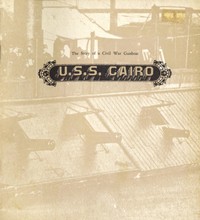
The source record for U.S.S. Cairo: The Story of a Civil War Gunboat Comprising a Narrative of Her Wartime Adventures by Virgil Carrington Jones, and an Account of Her Raising in 1964 by — Background and Themes measures this digital text at 12,173 words, 53 min estimated reading time, and 2 detected text sections.
The text analysis averages about 20.0 words per sentence, while the detected sections provide another way to judge how the source is divided.
Project Gutenberg metadata also associates the work with “United States -- History -- Civil War, 1861-1865 -- Naval operations,” connecting these edition facts with the source record’s subject description.
Explore this collection
These alternatives are selected using recorded categories and estimated reading time.
About 37 minutes
Modern Nations
8,438 recorded words. 16 minutes difference from this book's estimate.
View Gutenberg source #65372About 73 minutes
Modern Nations
16,627 recorded words. 20 minutes difference from this book's estimate.
View Gutenberg source #62163About 32 minutes
Modern Nations
7,315 recorded words. 21 minutes difference from this book's estimate.
View Gutenberg source #31991Search stored excerpts and compare books → Choose by your preferences →
Choices use stored catalog measurements. Estimates vary with reading speed. A shared category is a catalog label, not a claim that two books have the same argument or literary quality.
Search reads excerpt text stored with this catalog and links to its associated Gutenberg record. The connection is stored in the site database; this tool does not recheck that every excerpt is word-for-word identical to that external record. Excerpt search does not cover every chapter and does not verify historical publication dates.
Catalog snapshot checked: 2026-09-26. Coverage: 99 public books, 99 available source excerpts.
Calculated from edition completeness, EPUB availability, text structure and catalogue metadata. Not a user rating.
Total of 100 points, scaled to a 2.5-5.0 range. Editions with an empty description or a missing EPUB file are not scored.
Public-domain source text
The source text is kept in the dedicated reader, separate from this catalogue record and its commentary.
The catalog subjects for this work list the U.S. Civil War and the gunboat Cairo, but the text itself is a hybrid: Virgil Carrington Jones narrates the vessel's wartime service, while Harold L. Peterson describes its raising in 1964. The excerpts reveal a book that is less a continuous history than two distinct reports bound together, with the salvage account occupying roughly half the space. The foreword by Edwin C. Bearss frames the project as an interpretive tool for visitors to Vicksburg National Military Park, suggesting the intended audience is not general readers but park visitors seeking context for displayed artifacts.
Jones opens his section with a striking claim: “Some men and some ships seem fated for bad luck.” He immediately focuses on Captain Thomas O. Selfridge, Jr., whose service on three vessels whose names began with C—the Cumberland, the Cairo, and the Conestoga—all ended in sinking. This framing is notable because the catalog subject “Naval operations” might lead one to expect a broader tactical or strategic account. Instead, Jones narrows the lens to a single commander’s repeated misfortune, a personal angle that shapes the narrative. The excerpt does not describe battles or fleet movements; it dwells on character and fate. Readers should note that the complete wartime section likely follows this pattern, using Selfridge’s story as a thread through the Cairo’s brief career.
Peterson’s section shifts abruptly to a detective story. The salvage begins not with excavation but with triangulation: in 1956, Edwin C. Bearss, Warren Grabau, and Don Jacks used a pocket compass to detect the iron hull beneath the Yazoo River. The text emphasizes their methodological caution: “They wanted more tests, more data.” They worried that another sunken vessel might coincidentally match the Cairo’s specifications. This concern for certainty—waiting three years to confirm the wreck’s identity—contrasts with the wartime narrative’s reliance on anecdote and character. The catalog subject “Cairo (Gunboat)” implies a focus on the vessel itself, but Peterson’s account is equally about the process of historical detection, including the use of scuba divers in 1959 who worked blind in muddy water.
The book’s stated purpose, as given in the front matter, is to “interpret both the boat and the artifacts to visitors at the park.” This explains the dual structure: Jones provides the historical context for the Cairo’s sinking, while Peterson describes the recovery of “thousands of priceless artifacts.” The catalog subject “United States -- History -- Civil War, 1861-1865 -- Naval operations” is thus filtered through a preservationist lens. The excerpts do not describe any specific artifacts, but Peterson’s expertise in arms and armament suggests the recovered objects are central to the book’s latter half. Readers should expect the artifact discussion to be technical and descriptive, aimed at helping park visitors understand what they see in displays, rather than offering a narrative of naval combat.
Because the excerpts are limited to the opening of each section, the full book likely contains more detailed accounts of the Cairo’s sinking and the artifact recovery. Readers interested in Civil War naval operations should note that Jones’s narrative may be more biographical than tactical, while those drawn to underwater archaeology will find Peterson’s salvage story methodical and grounded in physical evidence. The book’s brevity—under 12,000 words—suggests it is a concise introduction rather than a comprehensive study.
That dual story of the Cairo—her wartime voyage and her slow, muddy return—left me oddly quiet for days. Something about how our old objects keep their own memories. It reminded me of the way family letters feel, half-forgotten voices surfacing. That quiet persistence is exactly what lingers in A Woman's Part in a Revolution — A Reader’s Guide too, I think. Just a feeling of history breathing underneath us.
Save your reaction, strongest insight, and memorable passage.