About 32 minutes
Some of My War Stories A Paper Read before the Ohio Commandery of the Loyal legion — Inside the Classic
Modern Nations
7,315 recorded words. 5 minutes difference from this book's estimate.
View Gutenberg source #31991
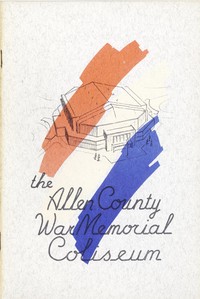
The Allen County War Memorial Coliseum — Edition Insights can be approached with a clearer sense of reading commitment from its source measurements: 8,438 words, 37 min estimated reading time, and 1 detected text section.
The text analysis averages about 19.9 words per sentence, while the detected sections provide another way to judge how the source is divided.
Project Gutenberg metadata also associates the work with “Allen County War Memorial Coliseum (Fort Wayne, Ind.),” connecting these edition facts with the source record’s subject description.
Explore this collection
These alternatives are selected using recorded categories and estimated reading time.
About 32 minutes
Modern Nations
7,315 recorded words. 5 minutes difference from this book's estimate.
View Gutenberg source #31991About 26 minutes
Modern Nations
5,808 recorded words. 11 minutes difference from this book's estimate.
View Gutenberg source #64730About 25 minutes
Modern Nations
5,594 recorded words. 12 minutes difference from this book's estimate.
View Gutenberg source #36673Search stored excerpts and compare books → Choose by your preferences →
Choices use stored catalog measurements. Estimates vary with reading speed. A shared category is a catalog label, not a claim that two books have the same argument or literary quality.
Search reads excerpt text stored with this catalog and links to its associated Gutenberg record. The connection is stored in the site database; this tool does not recheck that every excerpt is word-for-word identical to that external record. Excerpt search does not cover every chapter and does not verify historical publication dates.
Catalog snapshot checked: 2026-09-26. Coverage: 99 public books, 99 available source excerpts.
Calculated from edition completeness, EPUB availability, text structure and catalogue metadata. Not a user rating.
Total of 100 points, scaled to a 2.5-5.0 range. Editions with an empty description or a missing EPUB file are not scored.
Public-domain source text
The source text is kept in the dedicated reader, separate from this catalogue record and its commentary.
Otto H. Adams's 1954 pamphlet, originally a Quest Club address, documents the decade-long process of creating the Allen County War Memorial Coliseum. The text balances civic pride with practical details, noting that the project was first proposed by the Fort Wayne Junior Chamber of Commerce in 1944. Adams frames the coliseum as a 'living memorial,' a term borrowed from a Russell Sage Foundation study that praised such structures as a 'triumph of common sense over sentimentalism.'
The narrative moves from initial conception through financing and construction, culminating in a description of the completed building's features—including a $30,000 scoreboard donated by Wolf and Dessauer and an organ donated by Mrs. Ida Dick in memory of her husband. Adams, recently elected president of the Coliseum Board of Trustees, writes from an insider's perspective, drawing on supplementary information from the architect and manager.
The pamphlet opens by establishing the coliseum's dual purpose: to honor Allen County's war dead and to provide recreational facilities. Adams cites a Russell Sage Foundation study that endorsed 'living memorials' over ornamental monuments, a philosophy that shapes the entire project. The text traces the progression from the 1944 proposal through the formation of the War Memorial Commission in 1946 to the building's completion in 1952. Adams notes that the path was 'by no means smooth and uninterrupted,' hinting at challenges without elaborating. The language remains factual, relying on dates and organizational names rather than dramatic tension.
Adams describes the coliseum's layout with precision: the Sports Arena seats 6,000 for basketball and 7,500 for hockey, with a portable stage for theatrical productions. The Exhibition Hall occupies an acre and a quarter on the lower level, with its own box office, lobby, and concession stand, allowing concurrent events. Two features receive special attention: the electric scoreboard, purchased by Wolf and Dessauer for $30,000, and the organ donated by Mrs. Ida Dick. The scoreboard is noted as 'one of the finest existing scoreboards in the country,' a claim that reflects local pride. The description emphasizes functionality—ramps connect the two levels, and the hall hosts agricultural and industrial exhibits.
The pamphlet enumerates benefits to local organizations: the 4-H Clubs held their annual fair in the Exhibition Hall, untroubled by weather; the Boy Scouts served 1,500 guests at a recognition dinner; the Christ Child Festival occurs at Christmas; and regional high school basketball tournaments are now held in Fort Wayne. Adams also highlights economic impact: major sports events and famous entertainers bring visitors, increasing business for merchants, hotels, and restaurants. Sports announcers and reviewers give 'favorable publicity' to Fort Wayne because of the coliseum. The tone is promotional, but the examples are concrete and traceable to specific groups and events.
The pamphlet includes a biographical sketch of Otto H. Adams, who served on the War Memorial Commission from 1946 and later became president of the Coliseum Board of Trustees. His career includes roles as General Superintendent of City Utilities, City Controller, and controller at Zollner Machine Works. The text cites a Fort Wayne News-Sentinel editorial praising his 'notable facets of achievement in civic leadership.' Adams's involvement with the United Commercial Travelers, the National Foundation for Infantile Paralysis, the Red Cross, and the Y.M.C.A. situates the coliseum project within a broader network of mid-century civic organizations. The biography reinforces the pamphlet's theme of community accomplishment.
Readers should approach this pamphlet as a primary document of mid-century civic boosterism, not an objective history. Adams's insider perspective and the inclusion of specific donors and costs offer a window into how public-private partnerships operated in 1950s Fort Wayne. The text's brevity—under 9,000 words—makes it a quick but informative read for those interested in memorial architecture, local government, or the 'living memorial' movement.
There’s something steadying about rereading how a community built a gathering place on purpose, brick by brick, with the future in mind. It reminds me of tracing the measured, hopeful words in The Diplomatic Correspondence of the American Revolution, Vol. 09 — A Closer Reading — voices trying to shape something lasting out of uncertainty. Both feel like quiet conversations across time, still worth sitting with.
Save your reaction, strongest insight, and memorable passage.