About 25 minutes
Roster of Company I, 24th Regiment, Massachusetts Volunteers — Text and Context
Modern Nations
5,594 recorded words. 1 minutes difference from this book's estimate.
View Gutenberg source #36673
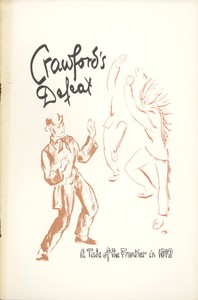
The catalog record for Crawford's Defeat: A Tale of the Frontier in 1812 — Themes and Context provides practical reading context through 5,808 words, 26 min estimated reading time, and 1 detected text section.
The text analysis averages about 24.4 words per sentence, while the detected sections provide another way to judge how the source is divided.
Project Gutenberg metadata also associates the work with “Mount Vernon (Ohio) -- History,” connecting these edition facts with the source record’s subject description.
Explore this collection
These alternatives are selected using recorded categories and estimated reading time.
About 25 minutes
Modern Nations
5,594 recorded words. 1 minutes difference from this book's estimate.
View Gutenberg source #36673About 32 minutes
Modern Nations
7,315 recorded words. 6 minutes difference from this book's estimate.
View Gutenberg source #31991About 37 minutes
Modern Nations
8,438 recorded words. 11 minutes difference from this book's estimate.
View Gutenberg source #65372Search stored excerpts and compare books → Choose by your preferences →
Choices use stored catalog measurements. Estimates vary with reading speed. A shared category is a catalog label, not a claim that two books have the same argument or literary quality.
Search reads excerpt text stored with this catalog and links to its associated Gutenberg record. The connection is stored in the site database; this tool does not recheck that every excerpt is word-for-word identical to that external record. Excerpt search does not cover every chapter and does not verify historical publication dates.
Catalog snapshot checked: 2026-09-26. Coverage: 99 public books, 99 available source excerpts.
Calculated from edition completeness, EPUB availability, text structure and catalogue metadata. Not a user rating.
Total of 100 points, scaled to a 2.5-5.0 range. Editions with an empty description or a missing EPUB file are not scored.
Public-domain source text
The source text is kept in the dedicated reader, separate from this catalogue record and its commentary.
The pamphlet opens with a foreword that frames the ensuing story as an example of Midwestern pioneer humor, immediately establishing a tension between the genuine terrors of frontier life and the comic relief of a practical joke. The narrative voice is that of a retrospective newspaper article from 1829, recounting events of 1812 with a formal, slightly archaic tone. The language is precise about geography and the mechanics of rumor: 'consternation that was frequently felt in neighborhoods and villages along the frontier.' The text is a hybrid—part historical record, part anecdote—and the editorial note that 'grammar, spelling, and punctuation have been changed to conform to current usage' signals a deliberate modernization of the original source.
The narrative begins with a grim catalog of frontier dangers: 'bloody scenes of this kind were described daily by visiting hunters and scouts.' The language is visceral, dwelling on 'the horrors of the tomahawk and the scalping knife' that 'continually preyed upon the minds of our wives and children.' This establishes a mood of pervasive fear. Then, abruptly, the tone shifts. A false alarm of an Indian raid sends the village into a panic, but the resolution is not a battle—it is a hoax. Two men, having fabricated the alarm, 'enjoyed some merriment at the expense of Crawford and the deluded villagers.' The pacing accelerates from dread to relief to laughter, and the word 'defeat' is repurposed from a military term to a joke. The structure mirrors the emotional rollercoaster of the anecdote itself.
The primary voice is that of the 1829 Indiana State Gazette writer, who adopts a collective 'our' and 'we' to speak for the community: 'our army at Detroit,' 'our wives and children.' This creates an intimate, communal perspective. The pamphlet’s editors, however, interject with a modernizing filter. They note that 'personal and place names are spelled as in the original narrative' but that grammar and punctuation have been updated. This dual voice—the raw 1829 account and the 1954 editorial framing—creates a layered reading experience. The reader is aware of the text’s history, and the editorial choices (like silently correcting 'a few typos') invite scrutiny of how historical narratives are preserved and altered.
The anecdote’s structure is deceptively simple: a rumor spreads, a search party is organized, and the 'enemy' is found to have fled. Only weeks later does the deception come to light. The text emphasizes the process of the joke—the two men 'laid themselves down in the shade to await the arrival of the appointed time for making their report.' This detail grounds the humor in a specific, almost leisurely act of deception. The phrase 'by common consent the affair was dubbed “Crawford’s Defeat”' shows how a community collectively renames an event, turning a moment of fear into a shared joke. The narrative does not judge Crawford; it simply records that the ruse was 'intended more particularly for one person,' leaving the reader to infer the social dynamics at play.
This pamphlet is best read as a document of both frontier history and narrative craft. The shift from a tone of genuine alarm to one of communal laughter is the work’s central effect. Readers should pay attention to the editorial apparatus—the foreword, the note on spelling changes—as they shape how the 1829 text is received. The brevity of the account (under 6,000 words) makes it a quick but layered read, rewarding attention to the interplay between the original newspaper voice and the modernizing hand of the 1954 editors.
That Crawford pamphlet reminds me of how a hoax can ripple through a quiet community, leaving laughter behind. I sometimes think of that when I close the Roster of Company I, 24th Regiment, Massachusetts Volunteers—a more somber record, yet both hold the same small, human tremor: men caught between fear and farce, between duty and confusion. Roster of Company I, 24th Regiment, Massachusetts Volunteers — Text and Context sits nearby on my shelf, a sober echo of that frontier jest.
Answer a few questions and save a private reflection on this device.