About 92 minutes
Zeppelin: The Story of a Great Achievement — Edition Insights
Modern Nations
21,045 recorded words. 19 minutes difference from this book's estimate.
View Gutenberg source #32570
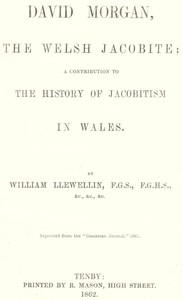
For David Morgan, the Welsh Jacobite a contribution to the history of Jacobitism in Wales — Edition Insights, the stored edition analysis reports 16,627 words, 1 hr 13 min estimated reading time, and 2 detected text sections.
The text analysis averages about 28.5 words per sentence, while the detected sections provide another way to judge how the source is divided.
Project Gutenberg metadata also associates the work with “Jacobites,” connecting these edition facts with the source record’s subject description.
Explore this collection
These alternatives are selected using recorded categories and estimated reading time.
About 92 minutes
Modern Nations
21,045 recorded words. 19 minutes difference from this book's estimate.
View Gutenberg source #32570About 53 minutes
Modern Nations
12,173 recorded words. 20 minutes difference from this book's estimate.
View Gutenberg source #59574About 99 minutes
Modern Nations
22,671 recorded words. 26 minutes difference from this book's estimate.
View Gutenberg source #8380Search stored excerpts and compare books → Choose by your preferences →
Choices use stored catalog measurements. Estimates vary with reading speed. A shared category is a catalog label, not a claim that two books have the same argument or literary quality.
Search reads excerpt text stored with this catalog and links to its associated Gutenberg record. The connection is stored in the site database; this tool does not recheck that every excerpt is word-for-word identical to that external record. Excerpt search does not cover every chapter and does not verify historical publication dates.
Catalog snapshot checked: 2026-09-26. Coverage: 99 public books, 99 available source excerpts.
Calculated from edition completeness, EPUB availability, text structure and catalogue metadata. Not a user rating.
Total of 100 points, scaled to a 2.5-5.0 range. Editions with an empty description or a missing EPUB file are not scored.
Public-domain source text
The source text is kept in the dedicated reader, separate from this catalogue record and its commentary.
The 1745 Jacobite rebellion is often framed as a romantic lost cause, but William Llewellin's account of David Morgan resists that simplification. Morgan's own words, delivered to the sheriff at his execution, form the core of this work—a legal defense that insists on the legitimacy of the Stuart claim and condemns the Revolution settlement as a source of national ruin. Llewellin juxtaposes this defiant statement with a narrative of the rebellion's aftermath, including the grisly disposal of rebels' bodies. The result is a study in contrasts: between the ballad's sentimental farewell and the scaffold's stark reality, between Morgan's constitutional arguments and the brute force that silenced them.
Morgan's execution paper, reproduced in full, is the work's most striking feature. It is not a confession but a legalistic assertion of King James III's title, citing the Statute of Charles II as still in force. Morgan argues that only a free parliament summoned by a lawful king can repeal that law—a position that brands the Revolution a usurpation. His language is precise: the Convention of 1688 was 'commanded by a foreign Prince and Usurper,' and the House of Hanover's accession has brought 'the intire Subversion of all that is dear and valuable to Britons.' This is not the rhetoric of a romantic rebel but of a man who believes he is defending the constitution. Llewellin lets the document stand without extensive commentary, allowing Morgan's own voice to dominate.
Llewellin details the post-execution fate of the rebels with clinical precision. The heads of Towneley and Fletcher were fixed on Temple Bar; those of Deacon, Berwick, Chadwick, and Syddal were preserved in spirits and sent to Manchester and Carlisle. Morgan's own head is unaccounted for—'it is probable that they were allowed to remain with the bodies.' This uncertainty contrasts with the careful record-keeping of the state's vengeance. The bodies were interred at the Foundling Hospital, a grim irony given the hospital's charitable purpose. Llewellin also notes the crowd's sympathy at the execution, a shift from the earlier hooting and insults. These details ground the rebellion in physical remains, resisting any purely symbolic reading.
Llewellin opens with a Jacobite ballad—'my last hoof, and horn, and hide, I'll gie for bonnie Charlie'—and a description of the rebellion as 'romantic and spirit-stirring.' But the body of the work undercuts that framing. Morgan's legal arguments, the graphic account of executions, and the author's own difficulty in tracing the disposal of heads all suggest a messier reality. Llewellin's tone is measured, even dry, as he notes that 'it is difficult to conceive the stormy struggles' from the vantage of peaceful times. This tension between the ballad's emotional appeal and the historian's factual restraint runs through the entire text. The reader is left to weigh the romance of lost causes against the constitutional and human costs that Llewellin documents.
Though the rebellion is often treated as a Scottish affair, Llewellin's focus on Morgan—a Welshman—offers a different angle. Morgan's statement makes no appeal to Welsh identity; his arguments are grounded in British constitutional law. Yet Llewellin's subtitle, 'A Contribution to the History of Jacobitism in Wales,' signals a regional dimension. The work itself is a reprint from the Cambrian Journal, suggesting an audience interested in local history. By centering a Welsh participant, Llewellin implicitly questions the assumption that Jacobitism was primarily a Highland or English Catholic movement. Morgan's legalism and his execution in Surrey complicate any simple geographic or religious mapping of the rebellion.
Readers should approach this text as a primary source in dialogue with its editor. Llewellin's framing is minimal, but his choices—reproducing Morgan's paper in full, noting the fate of each rebel's body, opening with a ballad—create a layered document. The work invites comparison between Morgan's own words and the historical record that surrounds them. It is best read alongside other accounts of the 1745 rebellion, not as a comprehensive history but as a focused case study in how one participant understood his cause and how that cause was physically erased.
Reading about David Morgan’s final words, I kept thinking how a life gets flattened into a verdict. That same ache follows you through Sword and Pen Ventures and Adventures of Willard Glazier — Text and Context—the man behind the deeds feels so close, yet the story keeps choosing the legend over him. It stayed with me quietly, like Morgan’s did.
Build a private reading journal entry for this title.