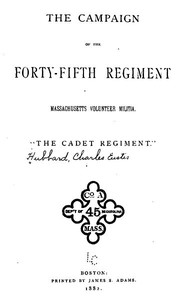
The Campaign of the Forty-fifth Regiment, Massachusetts Volunteer Militia "The Cadet Regiment" — Text and Context

(0 User reviews)   1276
In Category - Modern Nations
Hubbard, Charles Eustis, 1842-, Shapleigh, Frank H., 1842?-1906 [Illustrator] Project Gutenberg 2015 Not confirmed
United States -- History -- Civil War, 1861-1865 -- Regimental histories -- Massachusetts; United States. Army. Massachusetts Infantry Regiment, 45th (1862-1863) Readers of public-domain and historical texts
Project Gutenberg digital edition en

Edition facts

Words 36,267
Reading time 158 min
Text sections 5

The catalog record for The Campaign of the Forty-fifth Regiment, Massachusetts Volunteer Militia "The Cadet Regiment" — Text and Context provides practical reading context through 36,267 words, 2 hr 38 min estimated reading time, and 5 detected text sections.

The text analysis averages about 28.1 words per sentence, while the detected sections provide another way to judge how the source is divided.

Project Gutenberg metadata also associates the work with “United States -- History -- Civil War, 1861-1865 -- Regimental histories -- Massachusetts,” connecting these edition facts with the source record’s subject description.

A regimental history by a Company A member, based on private notes, recounting the 45th Massachusetts Volunteer Militia's 1862-1863 campaign in North Carolina, with a focus on daily life, marches, and the camaraderie of the 'Cadet Regiment.'
Share
Editorial Edition Score 4.7/5

Calculated from edition completeness, EPUB availability, text structure and catalogue metadata. Not a user rating.

How this score is calculated
  • Description quality20 pts
  • Title & short description10 pts
  • Source metadata20 pts
  • Text length15 pts
  • Chapters / structure15 pts
  • EPUB file integrity20 pts

Total of 100 points, scaled to a 2.5-5.0 range. Editions with an empty description or a missing EPUB file are not scored.

Edition quality

Read the Text

CAMP-LIFE AT READVILLE.

Shortly after the President's call for three hundred thousand nine months' men, in the summer of 1862, a meeting was held by the Independent Corps of Cadets, in their armory in Boston, to consider the expediency of organizing a nine months' regiment, of which that corps should be, as it were, the nucleus. The proposition being favorably received, application was speedily made to Governor Andrew by various members in favor of the movement, for permission to recruit for such a regiment, under the title of the Cadet Regiment, but officially to be known as the Forty-fifth Regiment Massachusetts Volunteer Militia.

Charles R. Codman of Boston, then adjutant of the cadets, was selected as future commander of the regiment, subject, however, to the approval of the line officers, who were themselves to be elected by their respective companies in accordance with the militia law of the state, prior to receiving their commissions from the governor. Recruiting officers canvassed the state, and the companies ranked in the order in which their respective rolls were filled.

Readville was selected as the rendezvous and camping-ground for the regiment, and on the twelfth of September, Company D went into camp at that place, followed at intervals by the other companies as they severally attained a size which would warrant a respectable appearance on drill and parade.

The camp was pleasantly situated on high ground, surrounded on three sides by other camps, while the fourth was skirted by woods, back of which, as a fitting background, rose the blue hills of Milton in all their beauty.

We were quartered in barracks, long wooden sheds running parallel to each other, and perpendicular to and facing the parade-ground. Back of each barrack, and separated by a street some twenty feet in width, were the little cook-houses, while still farther to the rear were the officers' quarters, quartermaster's department, etc.

The first night in camp was a novel one to most of us, and formed the entrance to a new phase of existence, a military life. We marched from the depot and were received with shouts of welcome by the companies already in camp. Halting in front of the barrack assigned us, the order to break ranks was the signal for a simultaneous rush of all to take possession of the movable bunks, which in two tiers lined both sides of the building, followed by another stampede after straw to fill them.

My first military duty was the scouring of sundry rusty pots and pans preparatory to the evening meal. All the true patriots came into camp with empty haversacks, determined to brave the soldier's fare at the outset, and our pride was at its height when, formed in line, we marched single file to the cook-house, and had doled out to us from its window, the huge slice of bread and dipper of coffee or tea.

"Truly, we are serving our country at last," we said, and ate our rations without thought of what we had left behind; but that slice of bread, varied often by hard-tack, so often, indeed, that the bread was the exception, and the dipper of coffee soon became an old, very old story, and the good things at home would rise in our memories, the ghosts of better times, and would not down at our bidding, nor would the hard-tack, either.

The interval between supper and roll-call was wisely spent in making our bunks comfortable for the night; and that first night the custom was instituted by our captain, of reading the lesson and prayers for the day after morning and evening roll-call; and was faithfully continued until the regiment went into tents, some seven months later.

Punctually at nine, taps sounded and the lights were extinguished, and as reveille was at half-past five, we naturally desired and expected to lose ourselves immediately; but alas! for the fallacy of human hopes, not an eye in that barrack was closed in sleep a moment before midnight, except, perhaps, that of one of our number, afterwards discharged for deafness. The evil one himself was, without doubt, on a rampage that night, and raised a very bedlam in our midst.

The preface of this regimental history reveals its unusual origin: a private memoir written shortly after the war by a member of Company A, later expanded by a committee of the 'Co. A Associates' for publication in 1882. The author, Charles Eustis Hubbard, draws on his own notes and the collective memory of his comrades, aiming to preserve 'the leading incidents of his army experiences' rather than produce an official record. The narrative voice is that of a participant, not a historian, and the text is punctuated by the specific, often wry observations of a soldier who endured the same mud, marches, and makeshift quarters as his fellows.

A Private Memoir Becomes a Regimental Record

The book's genesis is unusual: it began as a private account written by a Company A member 'for his own private gratification' shortly after mustering out. Only later, at a meeting of the 'Co. A Associates' in January of an unspecified year, was it voted to publish a history with illustrations. The committee, composed of fellow soldiers, expanded the original manuscript into the present volume. This backstory explains the text's intimate, anecdotal tone—it is a veteran's recollection, not a staff officer's report. The preface thanks Colonel Edward W. Kinsley, a civilian friend who 'played so important a part' in the regiment's story, and notes that his 'cheery presence' at reunions provided 'a bit of the inner history of the dark days in '62 and '63.' The reader should expect a narrative shaped by personal memory and the bonds of a company association, not a comprehensive strategic overview.

The Mud and Jokes of the Trenton Expedition

One of the most vivid passages describes a grueling march during the expedition to Trenton. The author notes that 'without exception, the hardest day in all our campaign' was also 'the merriest,' because 'in the army, the harder the work, and the more dismal the circumstances, the better humor the men will be in.' The march covered twenty-one miles in seven hours on 'the muddiest road it has ever been our lot to see.' The men returned without having fired a shot or lost a man. This episode illustrates the book's recurring theme: the soldiers' ability to find humor in misery. The author's voice is wry and self-aware, and he often pauses to remark on the paradoxes of army life. The reader should note how such set-pieces—the long march, the return to camp, the rumors of better quarters—structure the narrative and convey the texture of the campaign.

Quarters in Newbern: A Captured City's Domestic Details

When the regiment moved to Newbern in late 1862, Company A was assigned a house on Pollock Street, described as 'one of the prettiest places in the town.' The building had flower gardens, fruit trees, and a cook-house, but was 'wholly destitute of furniture.' The men improvised bunks in every room, with seventeen occupants in the parlor alone. The author notes that the house still bore the name 'Pierce' on the door, and he offers mock thanks to the absent owner for 'the noble manner in which he retired to the country and generously yielded up his house and grounds, rent free, to the use of the Yankee soldiery.' This blend of precise detail and dry humor is characteristic. The passage also situates the regiment within the larger occupation: across the street stood the former headquarters of 'General Hill, the rebel commander.' The reader gains a sense of how the soldiers made a home in a captured city, adapting civilian spaces to military life.

The Cadet Regiment's Voice: Between Formality and Familiarity

The narrative oscillates between formal regimental history and the casual tone of a company reunion. The author refers to the regiment as 'the 45th Mass., Colonel Codman commanding,' but also uses the first-person plural 'we' and addresses the reader as a fellow veteran. The text includes the full text of orders and official designations, yet it also recounts jokes, rumors, and the men's private opinions. This dual voice is a product of the book's dual purpose: to preserve the official record for posterity and to entertain the 'Co. A Associates' at their annual reunions. The reader should be alert to shifts in register—from the dry recitation of dates and distances to the wry asides about 'donkey-carts' and 'the best possible spirits.' The book is as much a memento for those who were there as it is a historical document for later readers.

This edition preserves the original 1882 text and illustrations by Frank H. Shapleigh, a fellow veteran. Readers should approach it as a primary source: a firsthand account filtered through the lens of a regimental association, rich in specific detail but necessarily partial. The narrative's strength lies in its evocation of the soldiers' daily experience—the mud, the bunks, the rumors, and the jokes—rather than in strategic analysis. For a fuller picture of the 45th's campaign, consult official records or other regimental histories; for the texture of a soldier's life, this account is invaluable.

There’s something about the Cadet Regiment’s quiet record of marches and shared tents that lingers, the way old loyalties do. It reminded me of David Morgan, the Welsh Jacobite a contribution to the history of Jacobitism in Wales — Edition Insights, another voice from a lost cause, clinging to its own small certainties. Both feel less like grand history and more like letters someone kept.

There are no reviews for this eBook.

0
0 out of 5 (0 User reviews )

Add a Review

Your Rating *
There are no comments for this eBook.

Reader reflection

What did you think of this book?

Answer a few questions and save a private reflection on this device.

Your progress 0 / 10
1

Have you finished this book?

2

What was your overall reaction to the book?

3

Would you recommend this book to another reader?

4

How demanding did the text feel?

Related eBooks