About 168 minutes
Nelka Mrs. Helen de Smirnoff Moukhanoff, 1878-1963, a Biographical Sketch — Themes and Context
Modern Nations
38,417 recorded words. 3 minutes difference from this book's estimate.
View Gutenberg source #22655
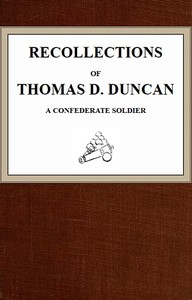
This digital edition of Recollections of Thomas D. Duncan, a Confederate Soldier — Edition Insights is described by source-level measurements including 37,919 words, 2 hr 45 min estimated reading time, and 4 detected text sections.
The text analysis averages about 27.2 words per sentence, while the detected sections provide another way to judge how the source is divided.
Project Gutenberg metadata also associates the work with “United States -- History -- Civil War, 1861-1865 -- Personal narratives, Confederate,” connecting these edition facts with the source record’s subject description.
Explore this collection
These alternatives are selected using recorded categories and estimated reading time.
About 168 minutes
Modern Nations
38,417 recorded words. 3 minutes difference from this book's estimate.
View Gutenberg source #22655About 159 minutes
Modern Nations
36,540 recorded words. 6 minutes difference from this book's estimate.
View Gutenberg source #37112About 171 minutes
Modern Nations
39,129 recorded words. 6 minutes difference from this book's estimate.
View Gutenberg source #54153Search stored excerpts and compare books → Choose by your preferences →
Choices use stored catalog measurements. Estimates vary with reading speed. A shared category is a catalog label, not a claim that two books have the same argument or literary quality.
Search reads excerpt text stored with this catalog and links to its associated Gutenberg record. The connection is stored in the site database; this tool does not recheck that every excerpt is word-for-word identical to that external record. Excerpt search does not cover every chapter and does not verify historical publication dates.
Catalog snapshot checked: 2026-09-26. Coverage: 99 public books, 99 available source excerpts.
Calculated from edition completeness, EPUB availability, text structure and catalogue metadata. Not a user rating.
Total of 100 points, scaled to a 2.5-5.0 range. Editions with an empty description or a missing EPUB file are not scored.
Public-domain source text
The source text is kept in the dedicated reader, separate from this catalogue record and its commentary.
Thomas D. Duncan opens his memoir by explicitly disclaiming literary ambition, stating that his work is 'not the product of a literary ambition' and that he writes primarily for his daughters and grandchildren. This framing as a family record shapes the entire narrative, which blends personal recollection with overt political and moral instruction. Duncan dedicates the book to teaching his grandsons 'two great truths': that the old South and its armies deserve 'devotion and respect forever,' and that the reunited nation is 'inseparable and eternal.' The tension between these two commitments—regional loyalty and national unity—runs throughout the text.
Duncan repeatedly insists that his memoir is not intended for public sale or literary acclaim. In the foreword, he writes that he has 'not sought to give it the wings of poetic fancy' and that he enters the work 'without any thought of placing a literary commodity upon the counters of the country.' Instead, he presents the recollections as something his children already knew from oral retellings—'oft-recounted recollections' that became 'a part of their education.' This domestic origin explains the book's informal, anecdotal structure. Duncan does not follow a strict chronological or analytical framework; he moves from campaign to campaign, often pausing to praise individual acts of bravery or to comment on the character of commanders. The dedication to his grandsons reinforces the pedagogical intent: the memoir is meant to instill specific values, not to provide a comprehensive history.
One of the most detailed episodes in the excerpts is the pursuit of Colonel Streight’s Union column through Alabama. Duncan emphasizes the role of Nathan Bedford Forrest, describing how Forrest 'would invariably discover' enemy traps and 'shell the ambush out.' The climax of this chase is the story of Emma Sanson, a fifteen-year-old girl who rode behind Forrest on his horse to point out a ford where her mother’s cows crossed. Duncan calls her act 'intelligent, fearless, and patriotic' and notes that the state of Alabama later granted her land and erected a monument. This anecdote illustrates Duncan’s tendency to highlight individual heroism and local loyalty. He also uses the episode to reflect on leadership, writing that 'the will and the genius of the commander are the preponderant power of every bannered host.' The Streight raid ends with the surrender of nearly 2,000 Union soldiers to Forrest’s 'little band of less than 500.'
Duncan’s account of the Battle of Chickamauga includes a pointed critique of General Braxton Bragg. He reports that after the battle, Forrest urged Bragg to press the retreating Union forces, but Bragg 'severely reprimanded him for what Bragg considered an undue interference.' Duncan adds that the breach between the two commanders 'was never healed.' He then offers his own judgment: 'if General Bragg had followed the advice of Forrest at Chickamauga, victory, so far as human vision can tell, would have been with the Confederates.' This is a rare moment of explicit opinion in a memoir that otherwise stays close to personal experience. Duncan does not claim to have witnessed the confrontation directly; he frames it as a story that 'further runs' and as a 'regrettable fact.' The passage reveals how Duncan uses his memoir to settle old scores and to advocate for a particular interpretation of military events.
Readers should approach this memoir as a deliberately partial account, shaped by Duncan’s desire to memorialize the Confederate cause for his descendants. The narrative is richest in its descriptions of cavalry operations and in its portraits of figures like Forrest, but it offers little about Duncan’s own emotions or daily life as a soldier. The book’s value lies less in its factual accuracy than in its demonstration of how one veteran chose to remember and teach the war sixty years later.
There’s a particular ache in reading Thomas Duncan’s plain-spoken reckonings with what he saw—war as wearying work, not glory. It reminds me of how even the most harrowing stories, told quietly and years later, hold more truth than any polished history. And I think of that other old account, The Complete Story of the Galveston Horror — A Reader’s Guide, sitting beside it on the shelf—one soldier’s memory, one city’s ruin—both whispering about how fragile it all was, and how strangely tender the remembering becomes.
Save your reaction, strongest insight, and memorable passage.