About 429 minutes
The Complete Story of the Galveston Horror — A Reader’s Guide
Modern Nations
98,625 recorded words. 16 minutes difference from this book's estimate.
View Gutenberg source #34304
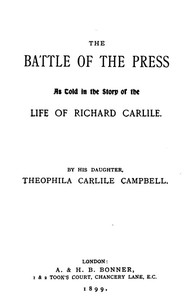
The catalog record for The battle of the press — Story, Setting & Ideas provides practical reading context through 102,297 words, 7 hr 25 min estimated reading time, and 12 detected text sections.
The text analysis averages about 22.6 words per sentence, while the detected sections provide another way to judge how the source is divided.
Project Gutenberg metadata also associates the work with “Manchester (England) -- History,” connecting these edition facts with the source record’s subject description.
Explore this collection
These alternatives are selected using recorded categories and estimated reading time.
About 429 minutes
Modern Nations
98,625 recorded words. 16 minutes difference from this book's estimate.
View Gutenberg source #34304About 422 minutes
Modern Nations
96,970 recorded words. 23 minutes difference from this book's estimate.
View Gutenberg source #74682About 416 minutes
Modern Nations
95,670 recorded words. 29 minutes difference from this book's estimate.
View Gutenberg source #70842Search stored excerpts and compare books → Choose by your preferences →
Choices use stored catalog measurements. Estimates vary with reading speed. A shared category is a catalog label, not a claim that two books have the same argument or literary quality.
Search reads excerpt text stored with this catalog and links to its associated Gutenberg record. The connection is stored in the site database; this tool does not recheck that every excerpt is word-for-word identical to that external record. Excerpt search does not cover every chapter and does not verify historical publication dates.
Catalog snapshot checked: 2026-09-26. Coverage: 99 public books, 99 available source excerpts.
Calculated from edition completeness, EPUB availability, text structure and catalogue metadata. Not a user rating.
Total of 100 points, scaled to a 2.5-5.0 range. Editions with an empty description or a missing EPUB file are not scored.
Public-domain source text
The source text is kept in the dedicated reader, separate from this catalogue record and its commentary.
Theophila Carlile Campbell, writing as Richard Carlile's daughter, frames her father's life as a deliberate campaign: 'to establish for his countrymen a really Free Press, and the right of free oral discussion.' The preface sets a combative tone, describing the 'malignity and religious fury' of the authorities and the public vilification that gave Carlile 'the horns, hoofs, and tail of Satan himself.' This editorial note examines how Campbell's diction, narrative structure, and use of private correspondence shape the portrait of a man whose personal and political battles were inseparable.
Campbell does not pretend neutrality. Her preface announces a 'desirable duty' to present a 'faithful account' of Carlile's sacrifices, and the language throughout is that of a partisan advocate. She describes the authorities' actions as 'assailed by the reigning powers with all the malignity and religious fury that characterised the days of the Inquisition.' Such phrasing aligns Carlile with martyred dissenters and frames the state as tyrannical. The repeated use of 'self-appointed task' and 'enormous sacrifices' elevates Carlile's agency while emphasizing the cost. This is not a detached biography but a vindication, written by someone who inherited both the cause and the personal losses it entailed.
Campbell incorporates letters from Carlile's second wife, Elizabeth Sharples (known as Isis), to reveal the emotional texture of their relationship. In one letter, Isis writes: 'My attachment becomes stronger every day. The more I see and know of you the more I admire, love, and esteem you.' The letters blend romantic devotion with political solidarity: 'Let us strengthen each other so as to be able to contend with existing evils, but let us never deviate one moment from our principles.' By including these private documents, Campbell shows that Carlile's domestic life was as much a site of ideological commitment as his public activism. The letters also serve as evidence of the personal costs—separation, anxiety, and the constant threat of imprisonment—that shaped the family's experience.
The book is divided into two parts: the first traces Carlile's life chronologically from birth to liberation; the second focuses on his relationship with Isis and his later years. This structure implicitly argues that Carlile's story cannot be told without his partnership with Sharples. Part II opens with 'The Story of Isis' and includes chapters of letters and memories, giving her a voice and a role beyond that of a footnote. The appendices—trial records, a letter to Lord Sidmouth, a dedication, and a list of imprisonments—function as documentary proof, reinforcing the book's claim to factual authority. Campbell's arrangement thus mirrors her dual aim: to narrate a life and to provide the evidentiary basis for its significance.
Imprisonment is not merely a plot point but a structuring motif. The chapter titles themselves—'Taken to Prison,' 'In Prison Again!', 'List of Carlile's Imprisonments'—emphasize the cyclical nature of persecution. Campbell describes a prison as witnessing 'such an exhibition of awakening love and almost perfect happiness,' transforming a site of punishment into a space of intellectual and emotional awakening. The repeated references to 'the Inquisition,' 'Satan,' and 'religious fury' create a lexicon of persecution that frames every legal action as an attack on liberty itself. This rhetorical strategy turns Carlile's multiple incarcerations into a unified narrative of martyrdom, where each imprisonment deepens his moral authority.
Campbell's biography is best read as a primary document of nineteenth-century radical memory, not a neutral history. Readers should attend to how the author's position as daughter shapes both the selection of evidence and the interpretive frame. The letters and trial records offer direct access to Carlile's world, but the polemical structure reminds us that this is a story told by a committed participant in the battle she describes.
Reading about Richard Carlile’s quiet endurance in his daughter’s words, I kept thinking how much disappears when we only get the bold headlines. That same hush sits inside The chronicles of Enguerrand de Monstrelet, Vol. 12 [of 13] — A Reader’s Guide, where the smaller, human moments behind old events feel closer than the dates ever do. It stayed with me like a half-remembered letter.
Use these questions to collect your thoughts before moving on.