About 478 minutes
The Missouri Persecutions — Themes and Context
Modern Nations
109,722 recorded words. 14 minutes difference from this book's estimate.
View Gutenberg source #49526
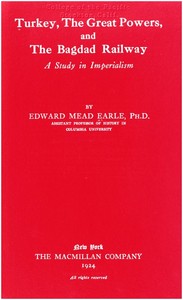
This digital edition of Turkey, the Great Powers, and the Bagdad Railway: A study in imperialism — A Closer Reading is described by source-level measurements including 113,153 words, 8 hr 12 min estimated reading time, and 16 detected text sections.
The text analysis averages about 20.8 words per sentence, while the detected sections provide another way to judge how the source is divided.
Project Gutenberg metadata also associates the work with “Eastern question,” connecting these edition facts with the source record’s subject description.
Explore this collection
These alternatives are selected using recorded categories and estimated reading time.
About 478 minutes
Modern Nations
109,722 recorded words. 14 minutes difference from this book's estimate.
View Gutenberg source #49526About 516 minutes
Modern Nations
118,678 recorded words. 24 minutes difference from this book's estimate.
View Gutenberg source #15478About 532 minutes
Modern Nations
122,151 recorded words. 40 minutes difference from this book's estimate.
View Gutenberg source #64131Search stored excerpts and compare books → Choose by your preferences →
Choices use stored catalog measurements. Estimates vary with reading speed. A shared category is a catalog label, not a claim that two books have the same argument or literary quality.
Search reads excerpt text stored with this catalog and links to its associated Gutenberg record. The connection is stored in the site database; this tool does not recheck that every excerpt is word-for-word identical to that external record. Excerpt search does not cover every chapter and does not verify historical publication dates.
Catalog snapshot checked: 2026-09-26. Coverage: 99 public books, 99 available source excerpts.
Calculated from edition completeness, EPUB availability, text structure and catalogue metadata. Not a user rating.
Total of 100 points, scaled to a 2.5-5.0 range. Editions with an empty description or a missing EPUB file are not scored.
Public-domain source text
The source text is kept in the dedicated reader, separate from this catalogue record and its commentary.
Edward Mead Earle opens his 1923 study not with a chronological narrative but with a pair of epigraphs that immediately establish the book's dual focus: the railway as a geopolitical pivot and the corrosive role of European financiers in Ottoman governance. The preface then pivots to an explicitly contemporary concern—American economic interests in the Near East—framing the historical analysis as a guide for policymakers. This rhetorical move, grounding a historical work in present-day relevance, recurs throughout the text as Earle alternates between detached scholarly exposition and pointed editorial commentary.
The effect is to transform what might be a dry policy history into something closer to a drama of personalities and perceptions. When Earle notes that only the St. James's Gazette supported British participation, and quotes its sardonic editorial—'Financiers are generally pretty wide-awake'—he is not merely cataloging press opinion but showing how public discourse shaped private decisions. The reader is left to weigh the financiers' self-interest against the government's caution, a tension Earle sustains without resolving.
Earle also uses the placement of quoted material to control emphasis. The Dawkins letter, introduced after a series of declarative statements, feels like a revelation—a private document that confirms what the historian has been implying. By withholding the letter until after he has established the context, Earle creates a sense of mounting evidence. The reader is drawn into the detective work of historical reconstruction, following the trail from public announcements to private correspondence.
The book also examines how imperial competition was framed in economic terms. The preface's reference to 'American economic interests in the natural resources of Asia Minor' echoes the language of the early twentieth-century financiers, suggesting a continuity of motive. Earle does not explicitly condemn this worldview, but by juxtaposing the financiers' self-justifications with the geopolitical consequences, he invites the reader to question the rhetoric of 'development' and 'progress.' The result is a study that is as much about the language of empire as about the railway itself.
Readers approaching this work should attend to the interplay between Earle's analytical framework and the primary sources he embeds. The book rewards those who read the footnotes and letters as carefully as the main text, for it is in these documents that the human dimensions of imperial rivalry emerge. Earle's own voice, though authoritative, is often most effective when it recedes, allowing the actors of the past to reveal their assumptions and anxieties. This is not a neutral chronicle but a carefully constructed argument about the dangers of economic nationalism—one that remains relevant a century later.
There’s something achingly poignant in how Earle’s book traces imperial machinery through dry ledgers, all those men far from the rails they fought over. It makes me think of a quieter kind of endurance, the one recorded in Notes of hospital life from November, 1861, to August, 1863 — Edition Insights, where the personal cost of larger forces is simply, gently noted. Time moves on, and still.
Your answers remain private and are stored only in this browser.