About 648 minutes
History of the Catholic Church from the Renaissance to the French Revolution — Volume 2 — Story, Setting & Ideas
Revolutions
149,025 recorded words. 257 minutes difference from this book's estimate.
View Gutenberg source #2455
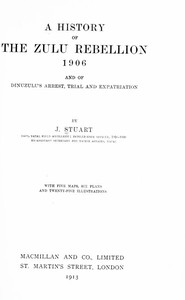
Before opening A history of the Zulu Rebellion, 1906, and of Dinuzulu's arrest, trial, and expatriation — Story, Setting & Ideas, the edition data offers a quick orientation: 207,963 words, 15 hr 5 min estimated reading time, and 30 detected text sections.
The text analysis averages about 20.4 words per sentence, while the detected sections provide another way to judge how the source is divided.
Project Gutenberg metadata also associates the work with “Zululand (South Africa) -- History,” connecting these edition facts with the source record’s subject description.
Explore this collection
These alternatives are selected using recorded categories and estimated reading time.
About 648 minutes
Revolutions
149,025 recorded words. 257 minutes difference from this book's estimate.
View Gutenberg source #2455About 379 minutes
Revolutions
87,143 recorded words. 526 minutes difference from this book's estimate.
View Gutenberg source #25261About 277 minutes
Revolutions
63,496 recorded words. 628 minutes difference from this book's estimate.
View Gutenberg source #64136Search stored excerpts and compare books → Choose by your preferences →
Choices use stored catalog measurements. Estimates vary with reading speed. A shared category is a catalog label, not a claim that two books have the same argument or literary quality.
Search reads excerpt text stored with this catalog and links to its associated Gutenberg record. The connection is stored in the site database; this tool does not recheck that every excerpt is word-for-word identical to that external record. Excerpt search does not cover every chapter and does not verify historical publication dates.
Catalog snapshot checked: 2026-09-26. Coverage: 99 public books, 99 available source excerpts.
Calculated from edition completeness, EPUB availability, text structure and catalogue metadata. Not a user rating.
Total of 100 points, scaled to a 2.5-5.0 range. Editions with an empty description or a missing EPUB file are not scored.
Public-domain source text
The source text is kept in the dedicated reader, separate from this catalogue record and its commentary.
Stuart opens his history by explaining the book's unusual origin: commissioned by the Natal government during the campaign, then abandoned by the Union government, leaving him to publish at his own expense with subscriber support. This preface immediately signals that the work straddles official and personal perspectives. The author, a former intelligence officer and Assistant Secretary for Native Affairs, writes from direct involvement, yet acknowledges the difficulty of completing the task while serving as a civil servant.
The narrative voice is methodical and detail-oriented, as seen in the battle accounts. Stuart describes a rebel charge at Mpukunyoni where the enemy used a "device" of advancing ahead to confuse cover, and notes that rebel gunfire, though poor, caused more casualties here than in any other action. He also observes that some rebels wore Turkey-red material, likely looted from a wagon, which made them indistinguishable from the Natal levies—a tactical detail that underscores the chaos of colonial combat.
Stuart's preface reveals that he was both participant and historian. He was asked to compile the military history while still serving as a civil servant, and later had to continue the work on his own responsibility after the Union government declined to ratify the original instructions. This dual role shapes the narrative: Stuart has access to official records and firsthand knowledge, but his account is not an official publication. He appeals to campaign participants for financial support, making the book a collaborative effort among veterans.
The text shows Stuart's insider perspective. He refers to specific units like the N.N.C., T.M.R., D.L.I., and Nongqai, and names officers such as Colonel McKenzie, Major Fraser, and Captain Robinson. He also critiques the performance of levies, noting that they deserted en bloc at a critical moment because they were not led by someone familiar with their language. This level of operational detail suggests Stuart relied on his own observations and after-action reports.
Stuart's battle descriptions emphasize terrain and movement. In one engagement, the enemy was found "on all sides, especially east of the donga," and the relief force had to descend "a steep incline nearly a mile away." He notes that the combined force drove through forest on the eastern side of the road, making towards Sibuda peak, with specific units on the left, centre, and right. The difficulty of the country is a recurring theme: troops worked "dismounted over exceedingly difficult country."
Stuart also records the arrival of reinforcements, such as the Natal Rangers under Lieut.-Col. Dick, and notes that their arrival was "most opportune." He mentions that the enemy seemed to have moved back to the Mome side of the forests, and that with the forces available, it was impossible to prevent such "breaking back." These passages show Stuart's awareness of the strategic limitations faced by the colonial forces.
Stuart provides precise casualty lists, naming the killed and wounded. In one action, four were killed: Corporal Alexander and Troopers Bouck, Harding, and Robertson. Eleven were wounded, including Capt. Clerk, Lieuts. Male and Oswald, and several troopers. He notes the severity of wounds: Clerk, Hawkins, Holmes, Hopkins, and Swart were wounded severely, and Hawkins died that evening. The attention to individual names and ranks reflects Stuart's military background and his desire to honor the fallen.
He also records the enemy's losses: "over 150 were killed, ten of them by Colonel Mansel's force." Over two hundred head of cattle were captured. This balance of reporting—listing both sides' casualties—is consistent with a military history that aims for factual completeness. Stuart does not dwell on the fate of the rebels beyond these numbers, but the inclusion of such data shows his methodical approach.
Stuart's preface makes clear that the book was originally intended as an official history but was left incomplete when the Union government declined to fund it. He notes that the work was "based as much on official" sources, but the sentence trails off in the excerpt, leaving the reader to infer that the book now rests on a mix of official documents and private initiative. This ambiguity is important: readers should be aware that while Stuart had access to official records, the final text is not government-sanctioned.
The excerpts also show that Stuart includes extensive quotations from other officers, such as the passage attributed to Colonel McKenzie: "All the units engaged inflicted severe losses on the enemy during the day's operations." This suggests that Stuart compiled reports from multiple commanders, giving the narrative a composite voice. The book thus functions as a repository of firsthand accounts, even as it maintains a single authorial perspective.
Readers approaching this history should note that Stuart's account is both detailed and partial: he was an active participant, and his narrative reflects the colonial military viewpoint. The book is best read as a primary source for the tactics, logistics, and command decisions of the Natal forces, rather than as a comprehensive study of the rebellion's causes or the Zulu perspective. The excerpts offer a window into the challenges of writing history from within the events themselves.
Reading Stuart’s careful notes on the rebellion, I remembered my grandfather’s ledger of tenant disputes—how power always writes its own testimony. That same ache surfaced again in The History of Woman Suffrage, Volume IV — Story, Setting & Ideas, where voices long unheard finally demanded the page. Both books feel less like history than like a held breath, waiting for someone to listen properly.
Build a private reading journal entry for this title.