The war drama of the Eagles — Background and Themes

(0 User reviews)   515
In Category - World Events
Fraser, Edward, 1859?- Project Gutenberg 2025 Not confirmed
Napoleonic Wars, 1800-1815 -- Campaigns; France -- History, Military; Napoleon I, Emperor of the French, 1769-1821 -- Military leadership Readers of public-domain and historical texts
Project Gutenberg digital edition en

Edition facts

Words 116,480
Reading time 507 min
Text sections 29

The catalog record for The war drama of the Eagles — Background and Themes provides practical reading context through 116,480 words, 8 hr 27 min estimated reading time, and 29 detected text sections.

The text analysis averages about 24.1 words per sentence, while the detected sections provide another way to judge how the source is divided.

Project Gutenberg metadata also associates the work with “Napoleonic Wars, 1800-1815 -- Campaigns,” connecting these edition facts with the source record’s subject description.

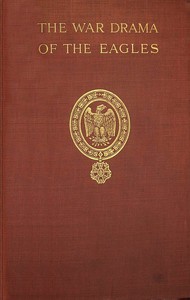
Edward Fraser's 1912 account of Napoleon's standard-bearers from Austerlitz to Waterloo, using firsthand reports to detail the capture and defense of regimental Eagles, with a focus on the physical struggle for these symbols.
Share
Editorial Edition Score 4.9/5

Calculated from edition completeness, EPUB availability, text structure and catalogue metadata. Not a user rating.

How this score is calculated
  • Description quality20 pts
  • Title & short description10 pts
  • Source metadata20 pts
  • Text length15 pts
  • Chapters / structure15 pts
  • EPUB file integrity20 pts

Total of 100 points, scaled to a 2.5-5.0 range. Editions with an empty description or a missing EPUB file are not scored.

Edition quality

Read the Text

ays before the meeting of the Council, he had directed a Committee to draw up a statement and offer suggestions.

The matter was brought forward at the first meeting of the Imperial Council, held at the Château of Saint-Cloud on Tuesday, June 12, 1804, after a preliminary discussion on the arrangements for the Coronation, when and where it should be held, and what was to be the form of ceremonial. The Coronation, all agreed at the outset, must take place in the current year. Rheims, Aix-la-Chapelle, and Paris, in turn, were suggested as suitable places for the ceremony, Paris being finally decided on; the scene of the event to be the Champ de Mars. Napoleon himself proposed the Champs de Mars, with a threefold ceremony there--the taking of the constitutional oath, the actual coronation, the presentation of the Emperor to the assembled people. A brief discussion followed on the form of the coronation ceremony, whether it should be accompanied by religious rites. It was put forward that, as Charlemagne had received his authority from the Pope, might not the Pope now be induced to visit Paris and personally crown the Emperor? Napoleon, intervening in the discussion, made a strong point of the necessity of some kind of religious service on the occasion. He did not care much, he cynically remarked, what religion was selected; only it must be in accordance with the views of the majority of the nation. It would be impossible to do without some sort of religious observance. In all nations, said he, Ceremonies of State were accompanied by religious services. As to asking the Pope to take part, from his point of view, at the moment, the attendance of a Papal legate would be preferable. If the Pope himself came to Paris, his presence would assuredly tend to relegate the Emperor to a secondary position: “Tout le monde me laisserait pour courir voir le Pape!” The matter, however, as the discussion proceeded, seemed to present so many difficulties, that the Council, after declaring themselves generally against having any religious ceremony at all, decided to leave the question for further consideration.

On that the Council turned to deal with the selection of the heraldic insignia and official badge of the Empire.

[Sidenote: THE GALLIC COCK PROPOSED]

Senator Crétet, on behalf of the special Committee appointed by Napoleon to prepare a statement for the Council, presented his report. The Committee, he said, had decided unanimously to recommend the Cock, the historic national emblem of Ancient Gaul, as the most fitting cognisance for Imperial France. Should that not find favour with the Council, either the Eagle, the Lion, or the Elephant, in the opinion of the Committee, might well be adopted. Individual members of the Committee, added Crétet, had further suggested the Aegis of Minerva, or some flower like the Fleur-de-Lis, an Oak-tree, or an Ear of Corn.

Miot, one of the members of the Council, rose as Crétet sat down, and protested against the re-introduction of the Fleur-de-Lis. That, he said, was imbecility. He proposed a figure of the Emperor seated on his throne as the best possible badge for the French Empire.

He was not seconded, however, and Napoleon interposed abruptly to set aside the Committee’s suggestion of reviving the Gallic Cock. He dismissed that notion with a contemptuous sneer. “Bah,” he exclaimed, “the Cock belongs to the farmyard! It is far too feeble a creature!” (“Le Coq est de basse cour. C’est un animal trop faible!”) Napoleon spoke rapidly and vivaciously. He had not yet, in those early days, acquired the impressive Imperial style that he afterwards affected. “His language at these earlier Council meetings was still impregnated with his original Jacobin style; he spoke frequently, spontaneously, familiarly; monologued at the top of his voice (avec des éclats de voix); apostrophised frequently, appearing at times as though overcome with nervousness, now almost in tears, now breaking out in a frenzy of passion, unrestrainedly emphasising his personal likes and dislikes.”

[Sidenote: THE LION--THE ELEPHANT--THE BEE]

Count Ségur, Imperial Grand Master of the Ceremonies, suggested the Lion as the most suitable emblem: “parcequ’il vaincra le Léopard,” he explained.

Councillor Laumond proposed the adoption of the Elephant instead; with for a motto “_Mole et Mente_.” The Elephant had a great vogue at that day among European heraldic authorities as being pre-eminently a royal beast. There was a widely prevalent belief, on the authority of old writers on natural history, that an Elephant could not be made to bow its knees. Further, too, the elephant typified resistless strength as well as magnanimity. And had not Caesar himself once placed the effigy of the Elephant on the Roman coinage? Nobody else at the Council, however, seemed to care for the Elephant.

Edward Fraser's The War Drama of the Eagles opens with a direct claim: the book breaks fresh ground by focusing on Napoleon's standard-bearers, a subject never before set forth. The preface frames the Eagles as objects of near-sacred devotion, quoting Napoleon's bulletins that losing an Eagle is an affront to a regiment's reputation. This sets a tone of high stakes, where the fate of a gilded bird on a pole mirrors the honor of entire units.

The excerpts reveal a narrative built around specific, often chaotic, moments of capture. Rather than broad strategy, Fraser zooms in on the tussle for the Eagle of the French 62nd at Salamanca, where Lieutenant Pierce grapples with a porte-aigle trying to unscrew the emblem and hide it. Such scenes ground the drama in physical detail, not just glory.

The Eagle as a Tangible Prize

The excerpts repeatedly emphasize the Eagle as a physical object to be seized, hidden, or carried off. At Salamanca, the French 62nd's Eagle is nearly concealed under a long overcoat before Lieutenant Pierce intervenes. The struggle involves multiple men: Pierce, two porte-aigles, and a French private who bayonets the British officer before being shot by Private Finlay. Fraser records that Pierce, in excitement, emptied his pockets and gave twenty dollars to the privates who helped him. The Eagle was then stuck on a sergeant's halberd and carried through the battle. Such details—the unscrewing, the overcoat, the halberd—make the trophy tangible, not abstract.

Fraser also notes that the 44th Regiment later bore a Napoleonic Eagle badge on its colors, and officers wore it on mess jackets. This connects the battlefield moment to lasting regimental identity, but the excerpts do not elaborate on the badge's design or official adoption.

Narrow Escapes and Camp Gossip

Not every Eagle was captured cleanly. Fraser includes a story of an Eagle that narrowly evaded capture by Hanoverian Dragoons of the King's German Legion after Salamanca, only to be taken later at Waterloo by the 1st Dragoons (the Royals). This cross-reference ties the narrative together, though the excerpts provide only the setup: General Anson's brigade, composed of British Light Dragoons and Hanoverians, pursued the French rearguard to Garcia Hernandez, where the 105th of the Line was moving in column with guns in the intervals. The ridge hid the infantry from view initially, leading to a near miss.

Fraser also reports rumors of two additional Eagles taken at Salamanca, one said to have wanted its head and number, but he dismisses these as possibly camp gossip. An officer reportedly carried one in his cap for days. This skepticism—noting that only two Eagles reached headquarters—shows Fraser weighing evidence, though the excerpts do not reveal his sources for the gossip.

The Role of Rank and File in Eagle Capture

Fraser's accounts highlight that Eagle captures often involved ordinary soldiers, not just officers. At Salamanca, Private Finlay of the 44th shot the Frenchman about to bayonet Lieutenant Pierce. The three privates who ran to Pierce's aid were rewarded on the spot with money. Similarly, Ensign Pratt of the 30th, attached to a Portuguese battalion, captured the Eagle of the 22nd of the Line and took it to General Pakenham, whose orderly displayed it publicly for two days. The orderly, likely a common soldier, carried the trophy wherever the general went.

These episodes suggest that Fraser aimed to show heroism across ranks, but the excerpts do not indicate whether he systematically covered lower ranks in other battles. The focus on individual actions—Pierce's tussle, Finlay's shot, Pratt's capture—gives the narrative a personal, almost anecdotal quality, rather than a tactical overview.

Fraser's Use of Official and Unofficial Sources

The excerpts show Fraser drawing on multiple types of evidence. He quotes Napoleon's bulletins and addresses, such as the 55th Bulletin of the Grand Army (1807) stating that loss of an Eagle is an affront no victory can amend. He also cites the presentation speech on the Field of Mars, where soldiers swore to sacrifice their lives for the Eagles. These official pronouncements frame the Eagles as sacred.

Yet Fraser also relies on what was widely reported in the Army and camp gossip, as with the two unconfirmed Eagles. He does not always distinguish between verified and hearsay, noting that one story had an officer carrying an Eagle in his cap for days. The preface claims the book offers independent testimony to British valor, but the excerpts do not reveal how Fraser verified the French accounts. The reader must weigh the mix of official bulletins, regimental traditions, and soldier anecdotes.

Fraser's narrative moves from the presentation of Eagles on the Field of Mars to the desperate attempts to hide or save them in defeat. Readers should note that the excerpts cover only a portion of the book, focusing on Salamanca and its aftermath. The full work likely extends from Austerlitz to Waterloo, as the title promises, and may include other battles where Eagles were lost or defended. The preface suggests a centenary context (1912), but the excerpts do not reveal how Fraser handled the broader chronology or whether he gave equal weight to each campaign.

That rainy afternoon, I kept thinking about Fraser’s soldiers clutching their Eagles, how a flag could mean more than ground. Later, the same weight of symbols surfaced in the wartime reports bundled in The New York Times Current History of the European War, Vol 1, Issue 4, January 23, 1915 — Inside the Classic, where another generation fought over similar certainties, though everything felt less certain now.

There are no reviews for this eBook.

0
0 out of 5 (0 User reviews )

Add a Review

Your Rating *
There are no comments for this eBook.

Reader reflection

What did you think of this book?

Answer a few questions and save a private reflection on this device.

Your progress 0 / 10
1

What is your current status with this title?

2

Did this book hold your interest?

3

How likely are you to recommend this book?

4

How demanding did the text feel?

Related eBooks