
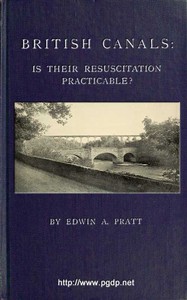
British Canals: Is their resuscitation practicable? by Edwin A. Pratt
Published in 1906, Edwin A. Pratt's book isn't a story in the traditional sense, but it has all the elements of a great drama: a fallen hero, powerful rivals, and a passionate plea for a second chance.
The Story
The 'plot' is the state of Britain's canals at the dawn of the 20th century. Pratt lays out the problem clearly: the canal system, once the superhighway of the Industrial Revolution, is in deep trouble. It's underfunded, fragmented between countless private companies, and losing the battle against the faster, more efficient railways. Many canals are already silted up and abandoned. Pratt then builds his case, chapter by chapter. He argues that with proper nationalization, standardization of locks and bridges, and investment in repairs, the canals could offer cheap, reliable transport for heavy goods like coal and timber. He uses data, cost comparisons, and examples from other countries to prove that reviving the canals isn't a romantic dream—it's a practical economic opportunity the country is foolishly ignoring.
Why You Should Read It
What grabbed me was Pratt's clear-eyed passion. He isn't just a nostalgic poet mourning the past; he's like a stubborn engineer presenting a business plan to save a failing company. You can feel his frustration with the short-sightedness of letting such a massive national asset decay. Reading this with modern eyes is a unique experience. You follow his logical, hopeful blueprint for a canal revival, all the while knowing that for the most part, it didn't happen. The railways (and soon, roads) won. This knowledge gives the book a poignant, almost prophetic quality. It’s a window into a road not taken for Britain's infrastructure.
Final Verdict
This book is perfect for anyone who loves industrial history, British landscapes, or underdog stories. If you enjoy walking canal towpaths today, this will make you see them in a completely new light—not just as peaceful trails, but as the faded blueprints of a different Britain. It's also a great read for anyone interested in how nations make (or fail to make) big decisions about technology and transport. It's more than a history book; it's a compelling argument from the past that still makes you think.
There are no legal restrictions on this material. You can copy, modify, and distribute it freely.
Karen Rodriguez
2 years agoInitially, I was looking for a specific answer, but the historical context mentioned in the early chapters is quite enlightening. It cleared up a lot of the confusion I had previously.







Elizabeth Martinez
1 year agoThe digital formatting makes it very easy to navigate.