
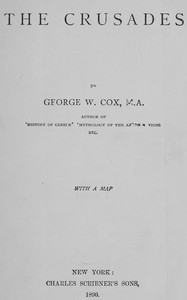
The crusades by George W. Cox
George W. Cox's The Crusades is a history book that feels like a grand, sprawling story. First published in the late 1800s, it walks you through the whole chaotic series of wars, from Pope Urban II's famous call to arms in 1095 to the final loss of Christian footholds in the Holy Land.
The Story
Cox lays out the journey of the Crusades like a long, painful road trip gone wrong. He starts with the spark: the Pope's promise of spiritual rewards for driving Muslims from Jerusalem. He then follows the waves of people who answered the call—not just disciplined knights, but also masses of poor peasants, zealots, and adventurers. The book tracks the major campaigns, the shocking violence of the First Crusade's capture of Jerusalem, the rise of famous orders like the Templars, and the legendary figures like Saladin and Richard the Lionheart. But Cox is just as interested in the fallout: the political schemes back in Europe, the strained relations with the Byzantine Empire, and the eventual, grinding failure of the whole enterprise.
Why You Should Read It
What makes this old history stand out is Cox's focus on the why behind the chaos. He connects the dots between faith, politics, and plain old human greed in a way that's still relevant. You see how religious passion was used to motivate people, but also how it was mixed with desires for land, power, and wealth. He doesn't paint the Crusaders as pure heroes or villains, but as complex people caught in a massive historical current. Reading it, you get a real sense of the medieval mindset—a world where heaven and earth felt much closer together, for better and for worse.
Final Verdict
This book is perfect for a reader who wants to go beyond a Wikipedia summary and really sink into the atmosphere and driving forces of the Middle Ages. It's a classic narrative history, so it's more about the flow of events and big ideas than cutting-edge archaeology. If you enjoy authors like Thomas Asbridge or Dan Jones, you'll appreciate Cox as a foundational voice in how we tell this story. Be ready for an older writing style, but if you stick with it, you'll find a compelling and surprisingly human account of one of history's most dramatic clashes.
This publication is available for unrestricted use. It is available for public use and education.
Margaret Smith
1 year agoI was particularly interested in the case studies mentioned here, the formatting on mobile devices is surprisingly crisp and clear. This should be on the reading list of every serious professional.
Robert Davis
6 months agoI appreciate how this edition approaches the core problem, the objective evaluation of the pros and cons is very refreshing. It cleared up a lot of the confusion I had previously.
Sarah Garcia
1 year agoClear, concise, and incredibly informative.
David Jones
1 year agoExtremely helpful for my current research project.
Sarah Lopez
1 year agoHaving read the author's previous works, the chapter on advanced strategies offers insights I haven't seen elsewhere. This adds significant depth to my understanding of the field.