
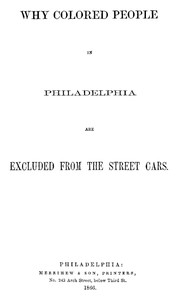
Why Colored People in Philadelphia Are Excluded from the Street Cars by Hunt
Published in 1866, this isn't a novel with a plot, but it tells a very clear story. Benjamin P. Hunt, a Philadelphia lawyer, lays out a simple, infuriating fact: Black residents of the city were barred from riding the public streetcars. He describes how conductors would refuse them service, often with insults, forcing men, women, and children to walk long distances regardless of rain, snow, or their health.
The Story
Hunt structures his case like a legal brief. He first establishes the injustice, painting vivid pictures of the humiliation faced daily. Then, he systematically dismantles every argument the streetcar companies used to justify this policy—arguments about lost business, passenger comfort, and social order. He uses logic, economic data, and appeals to basic human decency to prove these excuses are hollow. The real story he tells is about a city trying to rebuild after the Civil War while clinging to a cruel, illogical form of segregation in its very streets.
Why You Should Read It
This book hit me because of its directness. Hunt isn't writing for academics; he's trying to persuade his fellow citizens. You feel his frustration and moral outrage on every page. Reading his detailed account makes abstract terms like 'systemic racism' painfully concrete. You see how discrimination was woven into the daily mechanics of life—something as simple as getting to work or visiting a friend. It's also fascinating to see a white ally in that era using his platform so forcefully. The book is a snapshot of a battle in the long war for civil rights that was just beginning in the North.
Final Verdict
This is a essential, quick read for anyone interested in American history, civil rights, or urban life. It's perfect for readers who want to go beyond textbook summaries and hear an authentic voice from the past. It connects directly to modern conversations about public space and equality. Be warned: it's not an easy, feel-good story. It's an argument that will likely make you angry, but that's exactly why it's so valuable. Keep it on your shelf next to more famous works on race—it deserves to be part of the conversation.
This is a copyright-free edition. It is now common property for all to enjoy.
Elizabeth Thompson
10 months agoInitially, I was looking for a specific answer, but the inclusion of diverse viewpoints strengthens the overall narrative. I am looking forward to the author's next publication.
Michelle Ramirez
5 months agoThanks for the recommendation.
Linda Wilson
9 months agoI had low expectations initially, however the emotional weight of the story is balanced perfectly. Exactly what I needed.
Linda Smith
1 year agoMy professor recommended this, and I see why.
Christopher Wilson
1 year agoThe balance between academic rigor and readability is perfect.