About 96 minutes
Revolutionary Heroes, and Other Historical Papers — Text and Context
Social History
21,872 recorded words. 56 minutes difference from this book's estimate.
View Gutenberg source #8154
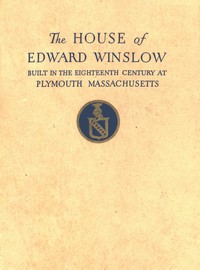
Before opening The Mayflower Society House Being the story of the Edward Winslow House, the Mayflower Society, the Pilgrims — A Reader’s Guide, the edition data offers a quick orientation: 9,159 words, 40 min estimated reading time, and 7 detected text sections.
The text analysis averages about 24.3 words per sentence, while the detected sections provide another way to judge how the source is divided.
Project Gutenberg metadata also associates the work with “Pilgrims (New Plymouth Colony),” connecting these edition facts with the source record’s subject description.
Explore this collection
These alternatives are selected using recorded categories and estimated reading time.
About 96 minutes
Social History
21,872 recorded words. 56 minutes difference from this book's estimate.
View Gutenberg source #8154About 192 minutes
Social History
44,063 recorded words. 152 minutes difference from this book's estimate.
View Gutenberg source #12675About 220 minutes
Social History
50,598 recorded words. 180 minutes difference from this book's estimate.
View Gutenberg source #49444Search stored excerpts and compare books → Choose by your preferences →
Choices use stored catalog measurements. Estimates vary with reading speed. A shared category is a catalog label, not a claim that two books have the same argument or literary quality.
Search reads excerpt text stored with this catalog and links to its associated Gutenberg record. The connection is stored in the site database; this tool does not recheck that every excerpt is word-for-word identical to that external record. Excerpt search does not cover every chapter and does not verify historical publication dates.
Catalog snapshot checked: 2026-09-26. Coverage: 99 public books, 99 available source excerpts.
Calculated from edition completeness, EPUB availability, text structure and catalogue metadata. Not a user rating.
Total of 100 points, scaled to a 2.5-5.0 range. Editions with an empty description or a missing EPUB file are not scored.
Public-domain source text
The source text is kept in the dedicated reader, separate from this catalogue record and its commentary.
The Edward Winslow House, built in 1754, stands on North Street in Plymouth—one of five streets laid out by the Pilgrims before 1633. Walter Merriam Pratt’s account moves between the house’s physical details and the broader story of the Mayflower Society that purchased it in 1941. The narrative is anchored by specific locations: the house overlooks Plymouth Rock and Cole’s Hill, where many Pilgrims are buried. Pratt repeatedly connects the building’s fabric to the people who inhabited it, from the Loyalist Edward Winslow to the Society members who preserved it.
The book opens by situating the house within Plymouth’s early street plan. North Street was first called New Street, later Queen Street, and then Howland Street—named for Joseph Howland, son of the Pilgrim John Howland. The land passed through several hands before Edward Winslow, great-grandson of Governor Edward Winslow, purchased it from Consider Howland. Winslow married Hannah Howland Dyer, Consider’s sister, and built the house in 1754. Pratt emphasizes these familial and geographical connections, showing how the house is embedded in the Pilgrims’ original settlement.
Edward Winslow was a Royalist who supported the King during the American Revolution. Pratt notes that Winslow’s lack of patriotism cost him his town offices and revenue. His son joined the British forces, and Winslow entertained British officers at the house. After the British evacuated Boston, Winslow moved his family to New York, then to Halifax, where he died. To support his family, he had mortgaged the house to Thomas Davis, William Thomas, Oakes Angier, and John Row. The narrative traces how political allegiance directly shaped the house’s fate.
Pratt interrupts the house’s story to reprint the Mayflower Compact, calling it “a great contribution to civil liberty and democracy.” He argues that the Compact ranks with the Declaration of Independence and the Constitution. The book’s structure places the Compact at the end, as noted by the transcriber, but Pratt’s text treats it as a centerpiece. He describes the Pilgrims as “unimportant people” who “made history” by forming a government by consent. This section shifts from architectural history to political philosophy, using the house as a backdrop for a broader argument about American governance.
Pratt repeatedly returns to the Mayflower’s voyage: the ship’s 180-ton burden, the leaky Speedwell, the ten-week crossing, and the landing at Cape Cod. He describes the Pilgrims’ decision to settle at Plymouth as pragmatic—“the best they had seen,” according to Elder Brewster. The image of the Mayflower sailing away in April 1621, leaving the survivors behind, is presented as “a more striking picture than her departure from England.” These maritime details recur throughout the book, linking the house’s location to the Pilgrims’ original journey and reinforcing the theme of endurance.
Pratt’s account is best read as a layered narrative that moves between a specific house, a family’s Loyalist history, and the Pilgrims’ foundational story. The book’s structure—alternating between architectural description, biographical sketch, and political commentary—reflects the Mayflower Society’s dual interest in preservation and historical commemoration. Readers attentive to how Pratt uses location, lineage, and the Compact as recurring motifs will find a coherent argument about how a single building can embody multiple layers of American memory.
That rainy afternoon, tracing the Winslow House’s quiet persistence through Revolutionary turmoil, left me longing for a sturdier, stranger domesticity—walls that remembered colder winters. Loosely following the Mayflower Society’s archival footnotes led me to Sketches and Tales Illustrative of Life in the Backwoods of New Brunswick Gleaned from Actual Observation and Experience During a Residence of Seven Years in That — Context and Discussion, its backwoods cabins feeling like the Winslow house’s wilder, untended cousins across the border.
Your answers remain private and are stored only in this browser.