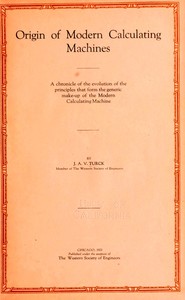
Origin of modern calculating machines by J. A. V. Turck
Forget everything you think you know about the history of computers. 'Origin of Modern Calculating Machines' by J.A.V. Turck takes you back to the very beginning, long before silicon chips and programming languages. This book isn't a timeline of products; it's an excavation of ideas.
The Story
Turck starts at the root of the problem: human calculation is slow and prone to error. He then guides us through the centuries-long quest to mechanize it. We meet the pioneers—like Charles Babbage with his visionary, steam-powered 'Difference Engine'—and the practical problem-solvers who created the first reliable adding machines and cash registers for businesses. The plot, so to speak, is the struggle to translate abstract mathematical concepts into gears, levers, and punched cards. It's a story of both spectacular failures and quiet breakthroughs that slowly built the foundation for everything that followed.
Why You Should Read It
What makes this book special is its focus on the mechanical elegance of early solutions. Turck helps you appreciate the sheer cleverness of a well-designed gear train performing a calculation automatically. You'll gain a real understanding of how a basic principle, like carrying a '1', can be engineered into metal. It demystifies the technology we take for granted by showing its humble, tangible beginnings. Reading this feels like getting a secret backstage pass to the invention of the modern world.
Final Verdict
This book is perfect for curious minds who enjoy 'how things work' documentaries, history buffs interested in the Industrial Revolution's intellectual side, and anyone who uses a computer every day but has no idea how it came to be. It's not a light beach read, but it's far from a dull academic text. It's for the reader who finishes an article and thinks, 'But how did they *start*?' If you've ever looked at your calculator or smartphone with a sense of wonder, this book will feed that curiosity and connect the dots in a deeply satisfying way.
This historical work is free of copyright protections. Share knowledge freely with the world.