
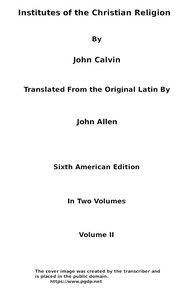
Institutes of the Christian Religion (Vol. 2 of 2) by Jean Calvin
Welcome back to the second half of our deep dive into one of history's most influential theological works. If the first volume of Calvin's Institutes was about establishing the core beliefs—God, creation, sin, and salvation—this volume is the user manual. Calvin shifts from theory to practice, explaining how these beliefs should shape every part of a believer's life and community.
The Story
There isn't a plot in the traditional sense, but there is a clear progression. Calvin starts with the individual's spiritual life, giving detailed instructions on prayer—its purpose, method, and content. He then expands the view to describe the entire Christian life as one of self-denial, cross-bearing, and hopeful anticipation of eternity. From there, he zooms out to the structures that support this life: the church (its authority, sacraments, and ministry) and finally, the civil government. He presents government not as a secular annoyance but as a divine institution meant to uphold justice and order, a concept that was revolutionary then and remains provocative now.
Why You Should Read It
I'll be honest: this isn't a beach read. But its power lies in its breathtaking scope. Calvin connects the dots between private devotion and public duty in a way that feels surprisingly cohesive. His section on prayer alone is worth the price of admission—it's humble, practical, and profound. What struck me most was his insistence that theology isn't just for scholars; it's for everyone, and it must touch everything. Whether he's discussing how to receive the Lord's Supper or the duties of magistrates, there's a relentless logic and a deep pastoral concern. You might disagree with his conclusions (many do!), but you can't accuse him of being vague or irrelevant.
Final Verdict
This book is perfect for history buffs, theology students, or anyone curious about the ideas that shaped the modern Western world. It's also for the thoughtful Christian who wants to understand the roots of their faith beyond simple slogans. You'll need some patience, but the payoff is a clearer picture of how one man's powerful synthesis of faith and reason sought to organize not just a church, but society itself. Approach it not as absolute truth, but as a fascinating, monumental conversation starter.
There are no legal restrictions on this material. It is now common property for all to enjoy.
Ashley Moore
1 year agoThe clarity of the concluding remarks is very professional.
Karen Miller
1 year agoInitially, I was looking for a specific answer, but the case studies and practical examples provided add immense value. I'm glad I chose this over the other alternatives.
Patricia Garcia
1 year agoAs a professional in this niche, the narrative arc keeps the reader engaged while delivering factual content. I'll be recommending this to my students and colleagues alike.
George Jones
1 year agoAs a long-time follower of this subject matter, the author’s unique perspective adds a fresh layer to the discussion. A rare gem in a sea of mediocre content.







Elizabeth Rodriguez
1 year agoI was skeptical about the depth of this book at first, but the logic behind each conclusion is easy to follow and verify. If you want to master this topic, start right here.