
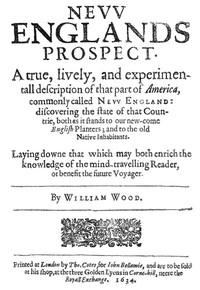
New Englands Prospect by active 1629-1635 William Wood
So, what's this book actually about? William Wood published it in 1634, hoping to convince more English people to pack up and move to New England. He structures it like a practical guide. The first part is a general survey: the climate, the coastline, the soil quality. He's a cheerleader, talking up the amazing resources. The second part gets more specific, describing the different settlements that already exist, from Plymouth to Boston. The final section is maybe the most fascinating for a modern reader: a detailed account of the Native American tribes, their customs, language, and appearance.
The Story
There isn't a traditional narrative with characters and a plot. The "story" is the journey of understanding itself. It's Wood trying to map and explain a world completely foreign to his audience. He walks you along the coast, pointing out good harbors. He lists animals, from the useful beaver to the terrifying (to him) rattlesnake. He tries to translate Algonquian words and describe complex social structures. The drama lies in his constant balancing act. He has to be honest enough to be believable, but optimistic enough to attract settlers. When he mentions the "pinching winter" or the "tormenting muskitoes," he quickly follows up with how to avoid or endure them. It's a survival guide wrapped in a promotional pamphlet.
Why You Should Read It
You should read it for the raw, unfiltered voice. This isn't a polished history written decades later. It's immediate. You feel Wood's genuine wonder at the new world—his amazement at a sky full of passenger pigeons so thick they block the sun. But you also feel his fear and bias. His descriptions of Native life are a messy mix of careful observation and deep cultural misunderstanding. Reading it, you become a detective, looking for the truth between the lines of propaganda. It gives you a sense of the sheer scale of the challenge, not in a dry historical way, but through the eyes of a man who was there, ankle-deep in the mud, trying to figure it all out.
Final Verdict
This book is perfect for history buffs who are tired of textbooks and want a primary source that crackles with personality. It's also great for anyone curious about early America, environmental history, or colonialism. It's a short, dense read, and the old-fashioned language takes a page or two to get used to, but it's worth the effort. Don't go in expecting a novel. Go in expecting a conversation with a very persuasive, slightly overwhelmed, 17th-century real estate agent who has seen some incredible things.
The copyright for this book has expired, making it public property. It is available for public use and education.
Christopher Anderson
1 year agoAfter a thorough walkthrough of the table of contents, it manages to maintain a consistent flow even when discussing difficult topics. I feel much more confident in my knowledge after finishing this.
Mason Martin
8 months agoGood quality content.
Edward Lewis
2 months agoFrom the very first page, the depth of research presented here is truly commendable. A true masterpiece.
Donna Hill
1 year agoGreat read!





Mary Thompson
2 months agoGiven the current trends in this field, the breakdown of complex theories into digestible segments is masterfully done. This is a solid reference for both beginners and experts.