
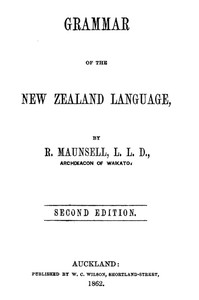
Grammar of the New Zealand language (2nd edition) by Robert Maunsell
Let's be clear from the start: this is not a novel. Robert Maunsell's "Grammar of the New Zealand Language" is a technical manual, published in 1862. It's a systematic breakdown of te reo Māori (the Māori language) as he understood it. The "plot" is the structure of the language itself. Maunsell lays out the alphabet, the parts of speech, the complex sentence structures, and provides countless examples. He wrote it primarily for other European missionaries and settlers, giving them the tools to learn and use the language.
The Story
The real story here isn't in a narrative, but in the context. Imagine a Victorian scholar, trained in Latin and Greek, sitting down to analyze a completely oral, Polynesian language. He's trying to force it into the grammatical boxes he knows—nouns, verbs, particles. The book itself is the record of that immense intellectual effort. You can see him figuring it out as he goes, making decisions about how to spell sounds and categorize ideas that had never been written down before. It's a foundational document, one of the first of its kind, created in the midst of rapid social change in New Zealand.
Why You Should Read It
You don't read this to learn Māori today (modern guides are far better). You read it to listen to history. On one page, you get a clear, careful explanation of a passive verb form. On the next, you might see a translated Biblical verse that feels awkward, showing the strain of fitting Christian concepts into Māori thought patterns. It's a snapshot of a specific moment when one culture was trying to systematically understand another. It’s humbling and a bit haunting. You're witnessing the very machinery of cross-cultural translation being built, with all its brilliant insights and inevitable biases. It makes you think deeply about how language shapes reality.
Final Verdict
This is a niche read, but a powerful one. It's perfect for language nerds, history enthusiasts, and anyone interested in New Zealand's colonial past. If you've ever wondered how dictionaries and grammars are born, this shows you the messy, groundbreaking work. It's not light bedtime reading; it's more like visiting an archaeological dig. You have to sift through the technical dirt to find the real treasures—the glimpses of a missionary's mind and the enduring structure of a beautiful language. Approach it as a primary source, not a textbook, and you'll find it utterly absorbing.
There are no legal restrictions on this material. Use this text in your own projects freely.
Mary Young
6 months agoIf you enjoy this genre, the plot twists are genuinely surprising. This story will stay with me.
Aiden Clark
2 months agoGreat read!




Paul Moore
2 years agoThe methodology used in this work is academically sound.