
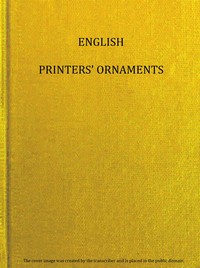
English printers' ornaments by Henry R. Plomer
If you think a book about typographical decorations sounds like a guaranteed snooze, I get it. I thought the same. But Henry R. Plomer's English Printers' Ornaments is a surprise. It's less of a textbook and more of a guided tour through the back alleys of early English publishing.
The Story
There isn't a traditional plot with characters. Instead, the 'story' is Plomer's investigation. He starts with a simple fact: in the 16th and 17th centuries, printers didn't just use plain text. They filled empty spaces with small, reusable metal decorations—flowers, animals, mythical creatures, intricate borders. Plomer noticed that these weren't random. Printers collected them like a toolkit, and they used the same sets for years. By becoming a 'ornament detective,' he could trace a specific piece of metal—a unique little star or a particular cherub—from one book to another. This let him figure out which printer worked on anonymous pamphlets, pinpoint publication dates, and even uncover when a printer sold his equipment to a rival. The book follows his evidence, showing how these tiny artworks solve big historical mysteries.
Why You Should Read It
This book gave me a whole new pair of eyes. It makes you see the physical book as a crafted object, full of intention. You realize that every space on a page was a decision. The ornaments were branding, a way for a printer to say, 'I made this,' in an age before title pages had their names. Some were sly digs at authorities or competitors. Reading Plomer is like getting a backstage pass to the gritty, competitive world that gave us Shakespeare's folios and the King James Bible. He has a clear passion for the subject that's contagious. He isn't just listing facts; he's showing you his method, inviting you to play along.
Final Verdict
This is a niche book, but a brilliant one for the right reader. It's perfect for history buffs, bibliophiles, or graphic designers who love seeing the origins of their craft. If you've ever enjoyed a 'how it's made' documentary or a true-crime investigation, you'll find the same puzzle-solving thrill here. It's not a light read—you have to want to look closely—but the reward is a secret understanding of how the books that built the modern world were actually put together, one tiny, beautiful piece of metal at a time.
This content is free to share and distribute. Use this text in your own projects freely.
Karen Clark
1 year agoAfter hearing about this author multiple times, it provides a comprehensive overview perfect for everyone. Don't hesitate to start reading.
Margaret Ramirez
1 year agoFast paced, good book.
Liam Hill
1 year agoVery interesting perspective.


Charles Lee
4 weeks agoI was particularly interested in the case studies mentioned here, it manages to maintain a consistent flow even when discussing difficult topics. I appreciate the effort that went into this curation.