
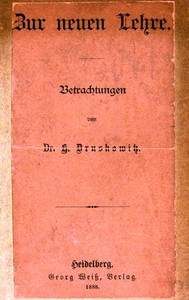
Zur neuen Lehre: Betrachtungen by H. Druskowitz
Let's set the scene: Vienna, late 19th century. Philosophy is dominated by big names and even bigger egos. Into this world steps Helene Druskowitz, one of the first women in Austria to earn a doctorate. 'Zur neuen Lehre' (which translates to 'On the New Teaching') is her manifesto. It's not a novel with a plot, but a series of powerful reflections and arguments that aim to tear down and rebuild.
The Story
Think of this less as a story and more as a brilliant, heated conversation you're overhearing. Druskowitz takes aim at the pessimistic philosophy of Arthur Schopenhauer and the emerging, provocative ideas of Friedrich Nietzsche. She argues that their worldviews, which often glorified suffering and a kind of heroic despair, are fundamentally flawed and even dangerous. Instead, she champions reason, compassion, and a more hopeful, life-affirming approach. She builds her 'new teaching' on the idea that we can and should create a better, more ethical world through clear thinking and empathy, rejecting what she saw as the toxic negativity of her famous contemporaries.
Why You Should Read It
First, it's a rediscovery. Druskowitz's work was suppressed and nearly lost to history, partly because of her gender and her later institutionalization. Reading her feels like an act of justice. Her writing is fiercely intelligent and surprisingly accessible. You can feel her passion and her frustration crackling off the page. Second, her critique feels startlingly modern. The debate between cynical worldviews and hopeful, constructive ones is still our debate today. Her voice is a clear, strong reminder that the philosophical canon we know is incomplete, and that some of the most relevant challenges to it came from the margins.
Final Verdict
This book is perfect for readers who love intellectual history, feminist perspectives, or anyone tired of the same old philosophical giants. It's for people who enjoy seeing an underdog fight back with sheer brilliance. It's not a light beach read, but it's a profoundly rewarding one. You'll come away not just with new ideas, but with a sense that you've met a formidable mind history tried to erase. A must-read for anyone who believes the best voices are sometimes the ones we've been taught not to hear.
You are viewing a work that belongs to the global public domain. Thank you for supporting open literature.
George Harris
2 months agoI've been looking for a reliable source on this topic, and the way it challenges the status quo is both daring and well-supported. A trustworthy resource that I'll keep in my digital library.
John Williams
10 months agoWhile browsing through various academic sources, it addresses the common misconceptions in a very professional manner. Highly recommended for those seeking credible information.
Ashley Williams
1 year agoAfter a thorough walkthrough of the table of contents, the author doesn't just scratch the surface but goes into meaningful detail. Definitely a five-star contribution to the field.
Linda Jackson
1 year agoThe methodology used in this work is academically sound.




Elizabeth Wilson
5 months agoThe citations provided are a goldmine for further academic study.