
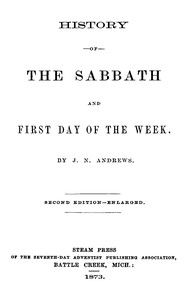
History of the Sabbath and first day of the week by John Nevins Andrews
Okay, let's break this down. This book isn't a novel—it's a detailed historical and theological investigation. But think of it as a non-fiction quest. The author sets out with one big question: From a biblical and historical standpoint, which day is the true Christian day of rest and worship?
The Story
The 'plot' follows the timeline of the Sabbath. Andrews starts at the very beginning, in the book of Genesis, establishing the seventh-day (Saturday) Sabbath. He then walks you through the Old Testament, the life of Jesus (who kept the seventh-day Sabbath), and the practices of the early Christian church. This is where the story gets interesting. He tracks the historical record, showing a gradual shift in the early centuries after Jesus. He points to writings from church fathers and notes the influence of Roman culture and sun-worship, arguing that these factors slowly pushed the common day of worship from Saturday to Sunday. He presents it as a historical puzzle, laying out the evidence piece by piece.
Why You Should Read It
I'll be honest, it's a scholarly work from the 1800s, so the language can feel a bit formal at times. But don't let that scare you off. The real value is in the sheer amount of research packed into it. Whether you agree with his conclusions or not, you have to respect the journey. It made me question something I'd always taken for granted. Why do we do things this way? Reading it feels like being a historical detective, sifting through ancient clues. It’s less about being convinced of one specific truth and more about understanding the complex, often surprising, journey of a major religious tradition.
Final Verdict
This book is perfect for history buffs, theology students, or anyone with a deep curiosity about Christian traditions. If you enjoy shows or podcasts that re-examine the origins of everyday things, you'll find the same kind of appeal here. It's probably not a casual weekend read, but more of a deep-thinking, 'let's figure this out' kind of book. If the question "Why Sunday?" has ever crossed your mind, John Nevins Andrews provides one of the most thorough and passionate investigations you're likely to find. Just be ready to take your time with it.
This masterpiece is free from copyright limitations. Thank you for supporting open literature.
Margaret Rodriguez
1 year agoI've gone through the entire material twice now, and the argument presented in the middle section is particularly compelling. I am looking forward to the author's next publication.
Joseph Smith
4 weeks agoThe clarity of the introduction set high expectations, and the case studies and practical examples provided add immense value. Well worth the time invested in reading it.
Jennifer Nguyen
2 months agoThis is one of those stories where it challenges the reader's perspective in an intellectual way. Exactly what I needed.
Amanda Martin
1 year agoThanks for the recommendation.



William Lee
3 months agoThe author provides a very nuanced critique of current methodologies.