
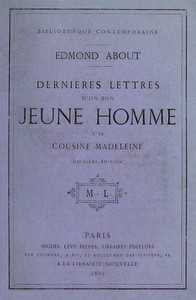
Dernières lettres d'un bon jeune homme à sa cousine Madeleine by Edmond About
Let's set the scene: France in the 1850s. We meet Henri, a clever and observant young man from the provinces, through the letters he sends to his favorite cousin, Madeleine, who lives in Paris. There's no grand quest or murder to solve. Instead, Henri writes about his daily life—his impressions of art and theater, his witty takes on the political scene under Napoleon III, his observations of the social climbers and characters in his orbit, and his own hopes and frustrations.
The Story
The story is entirely one-sided; we only have Henri's letters. Through them, we watch him navigate his entry into the adult world. He's trying to find a career, make his way in society, and understand his own heart. He confides in Madeleine with a mix of affection, intellectual boasting, and playful teasing. The letters are full of life and sharp humor. But the title, Last Letters of a Good Young Man, hangs over everything. We know from the start that this correspondence has an end point. As you read, you start looking for shadows, for hints of what might be coming. Is he in trouble? Is he ill? Or is the 'end' something more subtle, like the end of his youth or his innocence? The tension comes from getting to know a vivid personality, all while sensing a quiet clock ticking in the background.
Why You Should Read It
I fell for Henri's voice. Edmond About makes him feel incredibly real—he's not a hero, just a bright, sometimes vain, often funny guy trying to make sense of things. Reading his letters feels like finding a forgotten diary. The book is a brilliant snapshot of a specific time and place, but its heart is timeless: that universal struggle of figuring out who you are and what you want. It’s also surprisingly funny. Henri’s descriptions of pompous officials and silly fashion trends had me laughing. The real magic, though, is the relationship with Madeleine. Even though we never hear her replies, you can feel her presence through his words. You understand why he writes to her, and that unspoken bond gives the letters their warmth and their eventual sting.
Final Verdict
This isn't a book for someone craving fast-paced action. It's a character-driven, quiet novel for readers who love historical atmosphere and brilliant, conversational writing. Think of it as a long, fascinating chat with a clever friend from the past. It's perfect for fans of epistolary novels like Dangerous Liaisons or for anyone who enjoys sharp social satire wrapped in a very human story. If you've ever wondered about the real lives and thoughts behind the stiff portraits of the 19th century, Henri is your guide. Just be prepared to miss him when the last page turns.
This title is part of the public domain archive. Feel free to use it for personal or commercial purposes.
Charles Harris
2 months agoThis digital copy caught my eye due to its reputation, the author’s unique perspective adds a fresh layer to the discussion. It cleared up a lot of the confusion I had previously.
James Moore
6 months agoI wanted to compare this perspective with traditional views, the clarity of the writing makes even the most dense sections readable. Top-tier content that deserves more recognition.
David Hernandez
1 year agoI was skeptical about the depth of this book at first, but the author doesn't just scratch the surface but goes into meaningful detail. Definitely a five-star contribution to the field.
Robert Thomas
11 months agoI found the data interpretation to be highly professional and unbiased.




Sarah Lopez
3 months agoAs someone working in this industry, I found the insights very accurate.